This is the multi-page printable view of this section. .
PG Kernels
- 1: PostgreSQL
- 2: Supabase
- 3: Babelfish
- 4: Percona
- 5: openHalo
- 6: OrioleDB
- 7: Cloudberry
- 8: AgensGraph
- 9: pgEdge
- 10: DocumentDB
- 11: Citus
- 12: IvorySQL
- 13: PolarDB PG
- 14: PolarDB Oracle
- 15: PostgresML
- 16: Greenplum
- 17: Neon
In Pigsty, you can replace the native PostgreSQL kernel with different PostgreSQL “flavors” to unlock specialized capabilities.
Pigsty supports multiple PostgreSQL kernels and compatibility branches so you can get compatibility layers, multi-master replication, graph queries, MPP warehousing, transparent encryption, and more inside one operational framework.
One thing to keep in mind is that not every kernel has the same delivery depth in Pigsty:
PostgreSQL, Citus, Babelfish, IvorySQL, PolarDB, AgensGraph, and pgEdge already have relatively clear templates and configuration paths;
Cloudberry and Greenplum, by contrast, are more often managed through gpsql mode, and their MPP initialization plus scale-out operations are still better handled with upstream tooling.
| Kernel | Key Feature | Description |
|---|---|---|
| PostgreSQL | Native kernel, full extension set | Vanilla PostgreSQL with 575 extensions |
| Supabase | Backend as a Service | PostgreSQL-based BaaS, Firebase alternative |
| Citus | Horizontal scaling | Distributed PostgreSQL via native extension |
| Babelfish | SQL Server compatible | SQL Server wire-protocol compatibility (PG17/18) |
| IvorySQL | Oracle compatible | Oracle syntax and PL/SQL compatibility |
| OpenHalo | MySQL compatible | MySQL wire-protocol compatibility |
| Percona | Transparent data encryption | Percona distribution with pg_tde |
| DocumentDB | MongoDB migration | DocumentDB + FerretDB wire compatibility |
| OrioleDB | OLTP optimization | Zheap, no bloat, S3 storage |
| PolarDB | Aurora-style RAC | RAC, China-local compliance scenario |
| Cloudberry | Open-source MPP warehouse | Cloudberry integrated through gpsql mode |
| AgensGraph | Property graph + Cypher | Graph query capability inside PostgreSQL |
| pgEdge | Spock multi-master replication | Distributed PostgreSQL for edge scenarios |

Versions
| Kernel | Debian / Ubuntu | EL |
|---|---|---|
| PostgreSQL / Citus | PostgreSQL 18.6 (Ubuntu 18.6-1.pgdg26.04+1) on x86_64-pc-linux-gnu, compiled by gcc (Ubuntu 15.2.0-16ubuntu1) 15.2.0, 64-bit |
PostgreSQL 18.6 on x86_64-pc-linux-gnu, compiled by gcc (GCC) 14.3.1 20251022 (Red Hat 14.3.1-4), 64-bit |
| IvorySQL | PostgreSQL 18.4 (IvorySQL 5.4) on x86_64-pc-linux-gnu, compiled by gcc (GCC) 9.5.0, 64-bit |
PostgreSQL 18.4 (IvorySQL 5.4) on x86_64-pc-linux-gnu, compiled by gcc (GCC) 9.5.0, 64-bit |
| Babelfish | Babelfish 17.7 on x86_64-pc-linux-gnu, compiled by gcc (Ubuntu 15.2.0-16ubuntu1) 15.2.0, 64-bit |
Babelfish 17.7 on x86_64-pc-linux-gnu, compiled by gcc (GCC) 14.3.1 20251022 (Red Hat 14.3.1-4), 64-bit |
| PolarDB | PostgreSQL 17.10 (PolarDB 17.10.1.0 build accf02e2) on x86_64-linux-gnu |
PostgreSQL 17.10 (PolarDB 17.10.1.0 build accf02e2) on x86_64-linux-gnu |
| Percona | PostgreSQL 18.4 - Percona Server for PostgreSQL 18.4.1 on x86_64-pc-linux-gnu, compiled by gcc (Ubuntu 15.2.0-16ubuntu1) 15.2.0, 64-bit |
PostgreSQL 18.4 - Percona Server for PostgreSQL 18.4.1 on x86_64-pc-linux-gnu, compiled by gcc (GCC) 14.3.1 20250617 (Red Hat 14.3.1-2), 64-bit |
| OrioleDB | OrioleDB 18.4 (OrioleDB 1.8-beta16) on x86_64-pc-linux-gnu, compiled by gcc (Ubuntu 15.2.0-16ubuntu1) 15.2.0, 64-bit |
OrioleDB 18.4 (OrioleDB 1.8-beta16) on x86_64-pc-linux-gnu, compiled by gcc (GCC) 14.3.1 20251022 (Red Hat 14.3.1-4), 64-bit |
| OpenHalo | openHalo 14.18 on x86_64-pc-linux-gnu, compiled by gcc (Ubuntu 15.2.0-16ubuntu1) 15.2.0, 64-bit |
openHalo 14.18 on x86_64-pc-linux-gnu, compiled by gcc (GCC) 14.3.1 20251022 (Red Hat 14.3.1-4), 64-bit |
| DocumentDB | PostgreSQL 18.6 (Ubuntu 18.6-1.pgdg26.04+1) on x86_64-pc-linux-gnu, compiled by gcc (Ubuntu 15.2.0-16ubuntu1) 15.2.0, 64-bit |
PostgreSQL 18.6 on x86_64-pc-linux-gnu, compiled by gcc (GCC) 14.3.1 20251022 (Red Hat 14.3.1-4), 64-bit |
| AgensGraph | PostgreSQL 17.10 (AgensGraph 2.17.0) on x86_64-pc-linux-gnu, compiled by gcc (Ubuntu 15.2.0-16ubuntu1) 15.2.0, 64-bit |
PostgreSQL 17.10 (AgensGraph 2.17.0) on x86_64-pc-linux-gnu, compiled by gcc (GCC) 14.3.1 20251022 (Red Hat 14.3.1-4), 64-bit |
| pgEdge | PostgreSQL 18.4 (pgEdge 5.0.10) on x86_64-pc-linux-gnu, compiled by gcc (Ubuntu 15.2.0-16ubuntu1) 15.2.0, 64-bit |
PostgreSQL 18.4 (pgEdge 5.0.10) on x86_64-pc-linux-gnu, compiled by gcc (GCC) 14.3.1 20251022 (Red Hat 14.3.1-4), 64-bit |
| Cloudberry | PostgreSQL 14.4 (Apache Cloudberry 2.0.0-incubating build 1) on aarch64-unknown-linux-gnu, compiled by gcc (GCC) 11.5.0 20240719 (Red Hat 11.5.0-11), 64-bit |
1 - PostgreSQL
PostgreSQL is the world’s most advanced and popular open-source database.
Pigsty installs PostgreSQL 18 by default, supports PostgreSQL 14 ~ 18, and provides 575 PG extensions.
Quick Start
Install Pigsty using the pgsql configuration template.
Most configuration templates use PostgreSQL kernel by default, for example:
meta: Default, postgres with core extensions (vector, postgis, timescale)rich: postgres with all extensions installedslim: postgres only, no monitoring infrastructureha/full: 4-node sandbox for HA demonstrationpgsql: minimal postgres kernel configuration example
Configuration
Vanilla PostgreSQL kernel requires no special adjustments:
Version Selection
To use a different PostgreSQL major version, you can configure it using the -v parameter:
If a PostgreSQL cluster is already installed, you need to uninstall it before installing a new version:
Extension Ecosystem
Pigsty provides a rich extension ecosystem for PostgreSQL. See the Extension Catalog for details.
2 - Supabase
Supabase — Build in a weekend, Scale to millions
Supabase is an open-source Firebase alternative that wraps PostgreSQL and provides authentication, out-of-the-box APIs, edge functions, real-time subscriptions, object storage, and vector embedding capabilities. This is a low-code all-in-one backend platform that lets you skip most backend development work, requiring only database design and frontend knowledge to quickly ship products!
Supabase’s motto is: “Build in a weekend, Scale to millions”. Indeed, Supabase is extremely cost-effective at small to micro scales (4c8g), like a cyber bodhisattva. — But when you really scale to millions of users — you should seriously consider self-hosting Supabase — whether for functionality, performance, or cost considerations.
Pigsty provides you with a complete one-click self-hosting solution for Supabase. Self-hosted Supabase enjoys full PostgreSQL monitoring, IaC, PITR, and high availability, and compared to Supabase cloud services, it provides up to 575 out-of-the-box PostgreSQL extensions and can more fully utilize the performance and cost advantages of modern hardware.
For the complete self-hosting tutorial, please refer to: Supabase Self-Hosting Guide
Quick Start
Pigsty’s default supabase.yml configuration template defines a single-node Supabase.
First, use Pigsty’s standard installation process to install the Silo and PostgreSQL instances required for Supabase:
Before deploying Supabase, please modify the Supabase parameters in the pigsty.yml config file according to your actual situation (mainly passwords!)
Then, run docker.yml and app.yml to complete the remaining work and deploy Supabase containers:
For users in China, please configure appropriate Docker mirror sites or proxy servers to bypass GFW to pull DockerHub images. For professional subscriptions, we provide the ability to offline install Pigsty and Supabase without internet access.
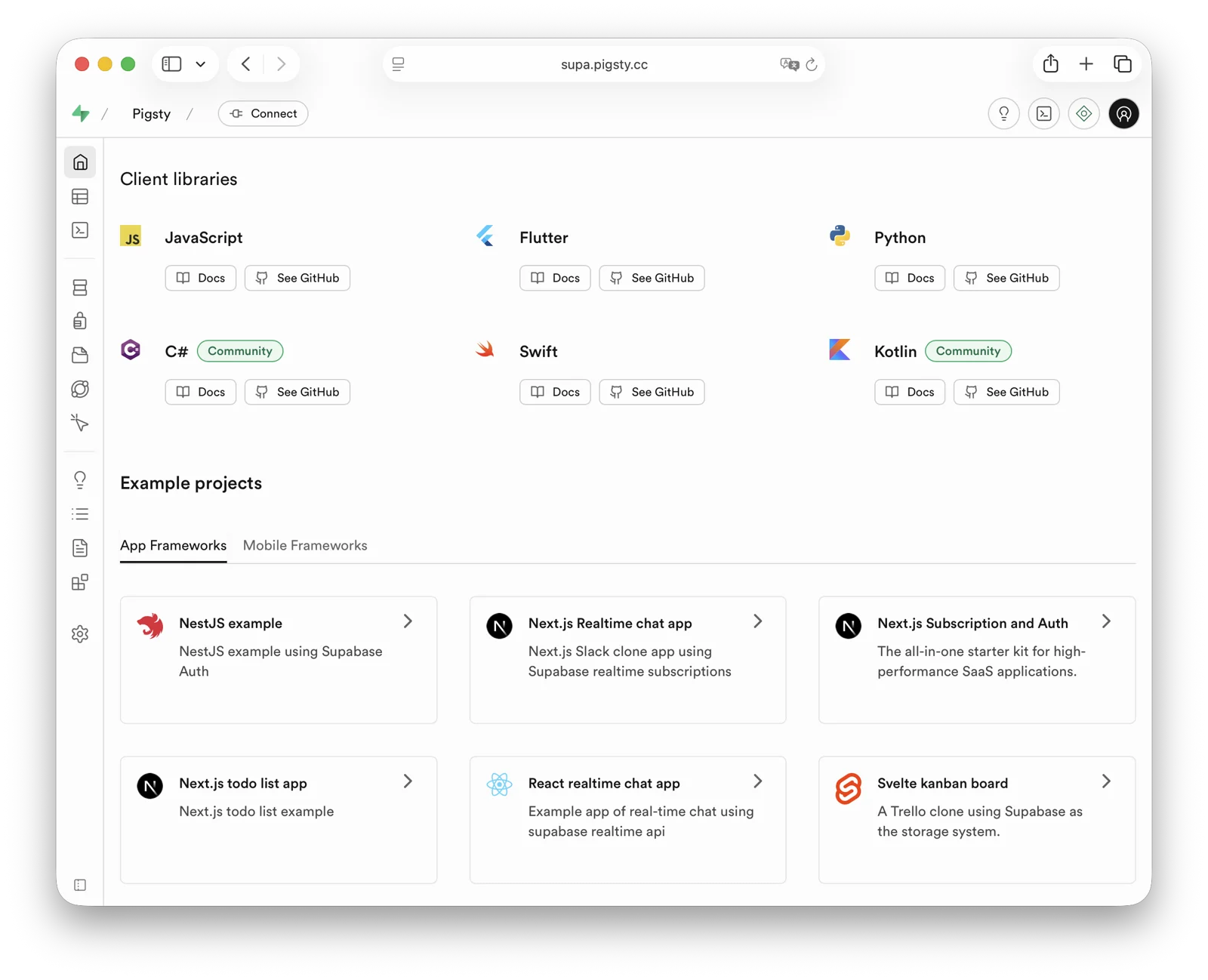
Pigsty exposes web services through Nginx on the admin node/INFRA node by default. You can add DNS resolution for supa.pigsty pointing to this node locally,
then access https://supa.pigsty through a browser to enter the Supabase Studio management interface.
Default username and password: supabase / pigsty
demo/supabase.cast — /demo/supabase.cast
3 - Babelfish
Babelfish is a PostgreSQL-based SQL Server compatibility layer, open-sourced by AWS.
Overview
Pigsty lets you deploy Babelfish in mssql mode and provide, on top of PostgreSQL:
- SQL Server wire protocol compatibility (TDS,
1433) - T-SQL compatibility
- Unified integration with Pigsty capabilities (HA, backup, monitoring, IaC)
In Pigsty v4, Babelfish supports PostgreSQL 17/18. The default template uses pg_version: 17, and Babelfish is part of Pigsty’s standard delivery path with support for all Linux platforms.
Current Behavior
Compared with older Babelfish/PG15 docs, current behavior is:
- Supported kernel majors are PG17/18; the template defaults to PG17 (
pg_version: 17) - Default package group:
babelfish + pgsql-common + sqlcmd - Mainstream platform coverage:
- OS:
el8,el9,el10,d12,d13,u22,u24,u26 - Arch:
x86_64,aarch64
- OS:
mssqltemplate no longer requires an extramssqlrepo module (defaults tonode,infra,pgsql)
Older docs may still contain deprecated naming. Pigsty now consistently uses
Babelfishandbabelfishaliases.
Quick Start
Use the built-in Pigsty template:
After deployment, connect directly with SQL Server clients:
Key Configuration
Core parameters in the mssql template:
Connectivity and Ports
Babelfish clusters expose two protocol endpoints:
- PostgreSQL protocol:
5432 - SQL Server protocol (TDS):
1433
With Pigsty service abstraction you can also use:
5433: fixed route to primary14335434: route to readable node1433
Notes
- Babelfish auth rules must use
md5instead of defaultscram-sha-256. - Default migration mode is
multi-db; switch withbabelfishpg_tsql.migration_modeif needed. - Not all native PostgreSQL extensions are directly usable on Babelfish kernels; validate package availability and compatibility first.
- Tighten HBA and network exposure for production; do not keep demo-level open rules.
Related Docs
Available Extensions
The Babelfish kernel has 55 available extensions. After removing bundled PG Contrib extensions, the following extra extensions remain:
| Extension | Version | Description |
|---|---|---|
| babelfishpg_common | 5.4.0 |
Transact SQL Datatype Support |
| babelfishpg_money | 1.1.0 |
babelfishpg_money |
| babelfishpg_tds | 1.0.0 |
TDS protocol extension |
| babelfishpg_tsql | 5.4.0 |
Transact SQL compatibility |
4 - Percona
Percona Postgres is a patched Postgres kernel with pg_tde (Transparent Data Encryption) extension.
Starting with v4.4.0, Pigsty packages Percona PostgreSQL under the private /usr/pgtde-$v; v4.5.0 keeps this layout
prefix (/usr/pgtde-18 for PostgreSQL 18). The pgtde package alias installs
both the kernel package and its contrib package, including pg_tde, PostGIS,
pgvector, wal2json, pg_repack, pgaudit, and pg_stat_monitor.
Quick Start
Use Pigsty’s standard installation process with the pgtde configuration template.
Configuration
The following parameters need to be adjusted to deploy a Percona cluster:
The pgtde packages are delivered by Pigsty’s pgsql repository module.
The legacy percona module is not required by this template.
Available Extensions
The Percona Postgres kernel has 73 available extensions. After removing bundled PG Contrib extensions, the following extra extensions remain:
| Extension | Version | Description |
|---|---|---|
| address_standardizer | 3.5.7 |
Used to parse an address into constituent elements. Generally used to support geocoding address normalization step. |
| address_standardizer_data_us | 3.5.7 |
Address Standardizer US dataset example |
| pg_repack | 1.5.3 |
Reorganize tables in PostgreSQL databases with minimal locks |
| pg_stat_monitor | 2.3.2 |
The pg_stat_monitor is a PostgreSQL Query Performance Monitoring tool, based on PostgreSQL contrib module pg_stat_statements. pg_stat_monitor provides aggregated statistics, client information, plan details including plan, and histogram information. |
| pg_tde | 2.2.1 |
pg_tde access method |
| pgaudit | 18.0 |
provides auditing functionality |
| postgis | 3.5.7 |
PostGIS geometry and geography spatial types and functions |
| postgis_raster | 3.5.7 |
PostGIS raster types and functions |
| postgis_sfcgal | 3.5.7 |
PostGIS SFCGAL functions |
| postgis_tiger_geocoder | 3.5.7 |
PostGIS tiger geocoder and reverse geocoder |
| postgis_topology | 3.5.7 |
PostGIS topology spatial types and functions |
| set_user | 4.2.0 |
similar to SET ROLE but with added logging |
| vector | 0.8.3 |
vector data type and ivfflat and hnsw access methods |
Key Features
- Transparent Data Encryption: Provides data-at-rest encryption using the pg_tde extension
- PostgreSQL 18 Compatible: Based on the Percona PostgreSQL 18 package set
- Enterprise Extensions: Includes enterprise-grade features like pgaudit, pg_stat_monitor
- Complete Ecosystem: Supports popular extensions like pgvector, PostGIS
Note: Currently in stable stage - thoroughly evaluate before production use.
5 - openHalo
OpenHalo is an open-source PostgreSQL kernel that provides MySQL wire-protocol compatibility.
openHalo is based on PostgreSQL 14.18 and provides wire-level compatibility with MySQL 5.7.32-log / 8.0. Pigsty delivers it through pg_mode: mysql and the openhalo package alias.
Pigsty supports OpenHalo deployment on all supported Linux platforms.
- RPM build spec: github.com/pgsty/rpm/rpmbuild/specs/openhalodb.spec
- DEB build spec: github.com/pgsty/deb/debbuild/openhalodb
Quick Start
Use Pigsty’s standard installation flow with the mysql template.
Cluster Config
OpenHalo provides a dedicated extension, aux_mysql, which includes functions and types needed for MySQL compatibility. Enable it in the postgres database to get full compatibility behavior.
- aux_mysql 1.5: MySQL Supplementary Extension
/usr/halo-14/share/postgresql/extension/aux_mysql.control$libdir/mysm,mysm.so
Usage
For MySQL access, connections still use the postgres database. The MySQL “database” concept maps to PostgreSQL “schema”. So use mysql maps to the mysql schema in the postgres database.
MySQL usernames/passwords are the same PostgreSQL credentials.
Client Access
OpenHalo listens on port 3306 for MySQL wire protocol clients.
Pigsty’s conf/mysql installs a MySQL client by default.
At present, OpenHalo upstream reports Navicat works normally on this port, while IntelliJ DataGrip may fail.
Compatibility Parameters
Pigsty defaults database_compat_mode to mysql. You can further tune compatibility behavior with settings like:
Patch Notes
The OpenHalo kernel packaged by Pigsty is based on HaloTech-Co-Ltd/openHalo with small adjustments:
- Restore default database name from
halo0roottopostgres - Remove
1.0.prefix in the default version string, keeping14.18 - Adjust default config to enable MySQL compatibility and listen on
3306
Pigsty does not provide warranty coverage for OpenHalo kernel behavior. Kernel-specific issues should be addressed with the upstream vendor.
Warning: This kernel is currently in beta1 stage; evaluate risks carefully before production use.
Available Extensions
The OpenHalo kernel has 59 available extensions. After removing bundled PG Contrib extensions, the following extra extensions remain:
| Extension | Version | Description |
|---|---|---|
| aux_mysql | 1.5 |
MySQL Supplementary Extension |
| hstore_plpython2u | 1.0 |
transform between hstore and plpython2u |
| hstore_plpythonu | 1.0 |
transform between hstore and plpythonu |
| jsonb_plpython2u | 1.0 |
transform between jsonb and plpython2u |
| jsonb_plpythonu | 1.0 |
transform between jsonb and plpythonu |
| ltree_plpython2u | 1.0 |
transform between ltree and plpython2u |
| ltree_plpythonu | 1.0 |
transform between ltree and plpythonu |
6 - OrioleDB
OrioleDB is a PostgreSQL storage engine extension that claims to provide 4x OLTP performance, no xid wraparound and table bloat issues, and “cloud-native” (data stored in S3) capabilities.
Pigsty ships OrioleDB as a patched PostgreSQL kernel plus the OrioleDB extension.
You can run OrioleDB as an RDS using Pigsty. Current packages support PostgreSQL 16, 17, and 18 on supported Linux platforms. pg_mode still uses oriole for the /usr/oriole-$v install path, while the orioledb package alias resolves to versioned kernel packages such as orioledb-16, orioledb-17, and orioledb-18.
The current Pigsty package line is OrioleDB 1.8 beta16.
Quick Start
Follow Pigsty’s standard installation process using the oriole configuration template.
For production deployment, ensure you modify the password parameters in the pigsty.yml configuration before running the install playbook.
Configuration
Usage
To use OrioleDB, install the orioledb package alias. Pigsty resolves it to the selected PG16, PG17, or PG18 OrioleDB kernel package according to pg_version.
Initialize TPC-B-like tables with pgbench using 100 warehouses:
Next, you can rebuild these tables using the orioledb storage engine and observe the performance difference:
Key Features
- No XID Wraparound: Eliminates transaction ID wraparound maintenance
- No Table Bloat: Advanced storage management prevents table bloat
- Cloud Storage: Native support for S3-compatible object storage
- OLTP Optimized: Designed for transactional workloads
- Improved Performance: Better space utilization and query performance
Note: Currently in Beta stage - thoroughly evaluate before production use.
Available Extensions
The OrioleDB kernel has 53 available extensions. After removing bundled PG Contrib extensions, the following extra extensions remain:
| Extension | Version | Description |
|---|---|---|
| orioledb | 1.8 |
OrioleDB – the next generation transactional engine |
7 - Cloudberry
gpsql mode.Cloudberry is an open-source MPP data warehouse kernel derived from the Greenplum ecosystem, suitable for large-scale parallel analytics workloads.
Overview
In Pigsty, Cloudberry uses gpsql mode and shares the same identity model, monitoring logic, and directory conventions as Greenplum / MatrixDB.
- Kernel package:
cloudberry - Mode identifier:
pg_mode: gpsql - Role flag:
gp_role: master | segment - Current repo version:
Cloudberry 2.1.0 - Current main package version: DEB
2.1.0-2PIGSTY, RPM2.1.0-3PIGSTY - Default binary directory:
/usr/cloudberry
The important boundary is this: Pigsty currently focuses on package delivery, node management, monitoring onboarding, access control, and configuration orchestration for Cloudberry. For MPP cluster initialization, scale-out, rebalance, and other upstream-specific operational actions, you should still use the official Cloudberry toolchain.
The current Pigsty repository provides
cloudberry,cloudberry-backup, andcloudberry-pxfpackages for both DEB and RPM platforms.
Installation
There is no standalone cloudberry one-click template yet. The more common workflow is:
- Enroll the target nodes into Pigsty.
- Install the
cloudberrykernel package. - Describe the coordinator / segment topology with
gpsqlmode. - Use Pigsty to unify monitoring, accounts, access control, and backup integration.
If you only need to install the kernel package on a node:
If you are onboarding an existing Cloudberry cluster, it is usually better to keep the original initialization workflow and add Pigsty inventory plus monitoring configuration incrementally.
Configuration
Cloudberry uses gpsql mode rather than a dedicated cloudberry mode. Compared with vanilla PostgreSQL, you at least need to care about the extra identity parameters pg_shard and gp_role; if you want to label shard groups explicitly, you can also add pg_group.
Here is a minimal readable topology example:
Two details are easy to miss:
gp_role: masteris for the coordinator / master node, and business access usually lands there.gp_role: segmentnodes usually needpg_exporterto connect inutilitymode for monitoring.
Client Access
For application and BI access, Cloudberry still exposes the PostgreSQL wire protocol, so most PostgreSQL-compatible clients, drivers, and BI tools can connect without special handling.
But keep the following in mind:
- Applications and analytics queries should connect to the master / coordinator, not directly to segment nodes.
- Segment nodes are better treated as data/compute shards and monitoring targets.
- If you want a unified access endpoint, you can still use Pigsty’s HAProxy / PgBouncer / DNS service abstractions.
Extensions and Ecosystem
Cloudberry comes from the PostgreSQL ecosystem, but it is not simply “vanilla PostgreSQL plus a few extensions”. For the extension packages already available in Pigsty, it is better to think in two categories:
- Pure SQL objects or components with weak ABI coupling are usually easier to adapt.
- Extensions that depend on PGXS or the kernel C ABI often need separate validation or even recompilation against the Cloudberry version and toolchain.
If your workload depends on postgis, vector extensions, FDWs, auditing, or custom C extensions, validate them on the target Cloudberry version first rather than copying a vanilla PostgreSQL extension list unchanged.
Notes
- Cloudberry currently has no dedicated Pigsty template, so you should model it manually with
gpsqlmode. - The current delivery focus is packages, configuration, and monitoring; it does not replace the official Cloudberry MPP initialization and scale-out toolchain.
- Because this is an MPP distributed kernel, vanilla PostgreSQL operational assumptions do not automatically transfer to every Patroni / PgBouncer / PgBackRest node role.
- If you need horizontal PostgreSQL scaling rather than a full MPP warehouse, Citus is usually the better first choice.
Related Docs
8 - AgensGraph
AgensGraph is a property graph database kernel built on PostgreSQL, supporting openCypher queries and mixed Cypher/SQL workflows.
Overview
Pigsty integrates AgensGraph through pg_mode: agens while preserving most of the standard PostgreSQL operational model.
- Kernel package:
agensgraph - Mode identifier:
pg_mode: agens - Current template version:
AgensGraph 2.17.0 - Current version string:
PostgreSQL 17.10 (AgensGraph 2.17.0) - Built-in template:
agens - Typical use cases: graph relationship analysis, path queries, knowledge graphs, and risk/association analysis layered onto relational data
From the client side, AgensGraph still speaks the PostgreSQL wire protocol, so normal PostgreSQL clients, drivers, and connection pools can connect directly.
The real difference from vanilla PostgreSQL is not how you connect, but that the database now contains graph objects, Cypher syntax, and the agtype data type.
Installation
Use the built-in Pigsty template:
The agens template automatically enables pg_mode: agens and installs the agensgraph kernel package. After deployment, verify the kernel version:
Configuration
Key configuration for AgensGraph in Pigsty:
AgensGraph does not require a special preload stack like pgEdge or Babelfish, so most standard Pigsty patterns for HA, backup, monitoring, access control, and IaC remain unchanged.
If your workload is dominated by graph traversal and complex path queries, focus on work_mem, shared_buffers, and planner cost settings instead of assuming default OLTP habits will fit.
Usage
After connecting to the database, the usual first step is to create a graph and set graph_path:
Create labels, vertices, and edges:
Run graph queries and updates:
To call Cypher from within SQL, use the cypher() function:
In real projects, the more common pattern is to mix “relational tables + graph labels + Cypher queries”:
transactions, privileges, and backup workflows still follow PostgreSQL, while graph analysis logic lives in AgensGraph graph objects and the cypher() interface.
Notes
- AgensGraph is currently fixed to the PG17-compatible line, so do not assume PG18 extension availability will carry over.
- The default
agenstemplate is single-node for quick validation; production deployments should extend to an HA topology. - Not all third-party PostgreSQL extensions are guaranteed to work on the AgensGraph kernel; verify compatibility first.
- Graph objects and relational objects can coexist in the same database, but in production it is usually better to define clear database or naming conventions so they do not become tangled together.
- Tune memory and cost parameters based on your graph model scale; do not blindly use defaults.
- For compatibility or semantic issues with the AgensGraph kernel, consult the official manual and upstream issues first.
Related Docs
- Pigsty config template:
conf/agens - PGSQL kernel mode config
- AgensGraph repository: https://github.com/skaiworldwide-oss/agensgraph
- AgensGraph official docs: https://tech.skaiworldwide.com/docs/en/agensgraph/latest/
- AgensGraph Quick Guide: https://tech.skaiworldwide.com/docs/en/agensgraph/17/quick_guide/index.html
- AgensGraph 2.17.0 Release Notes: https://tech.skaiworldwide.com/docs/en/agensgraph/latest/release_notes/agensgraph_release_notes_2_17_0.html
Available Extensions
The AgensGraph kernel has 60 available extensions. After removing bundled PG Contrib extensions, the following extra extensions remain:
| Extension | Version | Description |
|---|---|---|
| meta | 1.0 |
Utility functions for agensgraph |
9 - pgEdge
pgEdge is a distributed PostgreSQL distribution for edge scenarios, built on Spock multi-master logical replication.
Overview
Pigsty integrates pgEdge through pg_mode: pgedge and delivers it through the standard PostgreSQL cluster workflow:
pgedge: a PG15, PG16, PG17, and PG18 compatible kernel; the template defaults to PG18spock: Active-active multi-master logical replicationsnowflake: Distributed unique sequenceslolor: Large object logical replication compatibility layer
The current Pigsty repository ships versioned pgEdge kernel packages for pgedge-15, pgedge-16, pgedge-17, and pgedge-18; the template defaults to pg_version: 18. The spock, snowflake, and lolor control files, SQL files, and shared libraries are bundled in the pgedge-$v kernel package, so they are no longer listed as separate pg_extensions packages to install.
From the client side, pgEdge is still PostgreSQL wire compatible, so psql, JDBC/ODBC, DBeaver, and similar tools work as usual.
The delivery model in Pigsty is: validate the kernel on a single node first, then expand to a multi-node replication topology. The template handles the kernel, extensions, monitoring, backup, and access control out of the box, but the actual multi-master topology still needs to be designed around your workload consistency and conflict strategy.
Installation
Use the built-in Pigsty template:
The template pre-installs spock, snowflake, and lolor in the meta database. After deployment, verify the kernel and extensions:
For the full template and parameters, see:
pgedgeconfig template.
Configuration
Key parameters in the pgedge template (matching conf/pgedge.yml):
If you plan to grow into a multi-node multi-master topology, it is better to configure logical replication capacity and snowflake.node explicitly:
snowflake.node must be unique on every writable node, otherwise distributed IDs will collide.
Usage
The common workflow in Pigsty is still: validate the kernel on a single node first, then expand into a multi-node Spock replication topology.
If you need these capabilities in a business database as well, create the extensions first:
Then use the Spock SQL API or the pgEdge CLI to create nodes, replication sets, and subscriptions.
If your schema already uses serial or identity, plan the snowflake sequence migration before enabling multi-master writes, otherwise cross-node primary key collisions are likely.
Notes
- Replication in pgEdge is organized per database, not as an instance-wide “turn everything into multi-master” switch.
- Replicated tables should have a
PRIMARY KEYor an appropriateREPLICA IDENTITY. UNLOGGEDandTEMPORARYtables do not participate in Spock logical replication.- Spock configuration and operations typically require superuser privileges, so production deployments should define privilege boundaries clearly.
- If your workload depends on large object replication, use
lolorexplicitly rather than assuming native large objects will replicate correctly. - Cross-region multi-master is not a checkbox feature. Network latency, conflict handling, and the write model all need to be evaluated first.
Related Docs
- PGSQL Kernel Overview
pgedgeconfig template- PGSQL kernel mode config
spockextensionsnowflakeextensionlolorextension- pgEdge official docs
- Spock Limitations
- Snowflake Sequences
Available Extensions
The pgEdge kernel has 63 available extensions. After removing bundled PG Contrib extensions, the following extra extensions remain:
10 - DocumentDB
DocumentDB is an open-source PostgreSQL document database extension maintained by Microsoft. FerretDB is a stateless protocol translation proxy built on top of it. Together, they expose a MongoDB wire-compatible endpoint from a standard PostgreSQL kernel: applications using MongoDB drivers can connect directly, while requests are translated into PostgreSQL operations.
Unlike other kernel variants, this is not a standalone PostgreSQL fork. The data layer runs native PostgreSQL 16–18 and is managed by the standard PGSQL module.
Persistence, transactions, high availability, backup, monitoring, and access control remain PostgreSQL responsibilities; FerretDB is deployed as a Pigsty Docker APP and handles only protocol translation.
Pigsty is a FerretDB community partner, provides binary packages for FerretDB and the DocumentDB extensions,
and delivers the complete stack out of the box through the mongo configuration template.
Quick Start
Use Pigsty’s standard installation flow with the mongo configuration template:
FerretDB listens on the local loopback address at port 27017 by default. Connect with mongosh or any MongoDB-compatible client:
Configuration
Source: pigsty/conf/mongo.yml. See the Mongo configuration template documentation for the complete template.
The key PostgreSQL settings are the documentdb extension and its preload libraries, plus the backend superuser used by FerretDB:
FerretDB is deployed as a Docker APP. Its settings are ordinary overrides under apps.ferretdb.conf,
and the container connects to the local primary service on port 5436 through host.docker.internal:
High Availability
Because FerretDB is fully stateless, its HA topology follows the standard PostgreSQL cluster pattern. The template retains a commented three-node pg-mongo example.
Each node runs a FerretDB container bound to local port 27018, and HAProxy aggregates them behind the floating endpoint 10.10.10.4:27017 (mongo.pigsty).
Patroni and etcd continue to manage PostgreSQL failover. The Mongo endpoint automatically recovers after the primary switches.
Notes
- FerretDB enables authentication by default (
FERRETDB_AUTH: true) but does not yet implement MongoDB authorization roles. PostgreSQL users and HBA rules remain the actual security boundary. - Client-side MongoDB TLS is disabled by default, and the Mongo endpoint is not exposed to the network. Change
FERRETDB_BIND_ADDRonly when remote access is required. - The backend cluster uses standard PostgreSQL parameters, playbooks, and dashboards; there is no independent FERRET module or
mongo_*parameter group. - Repeat an authenticated CRUD smoke test after upgrading FerretDB or DocumentDB.
11 - Citus
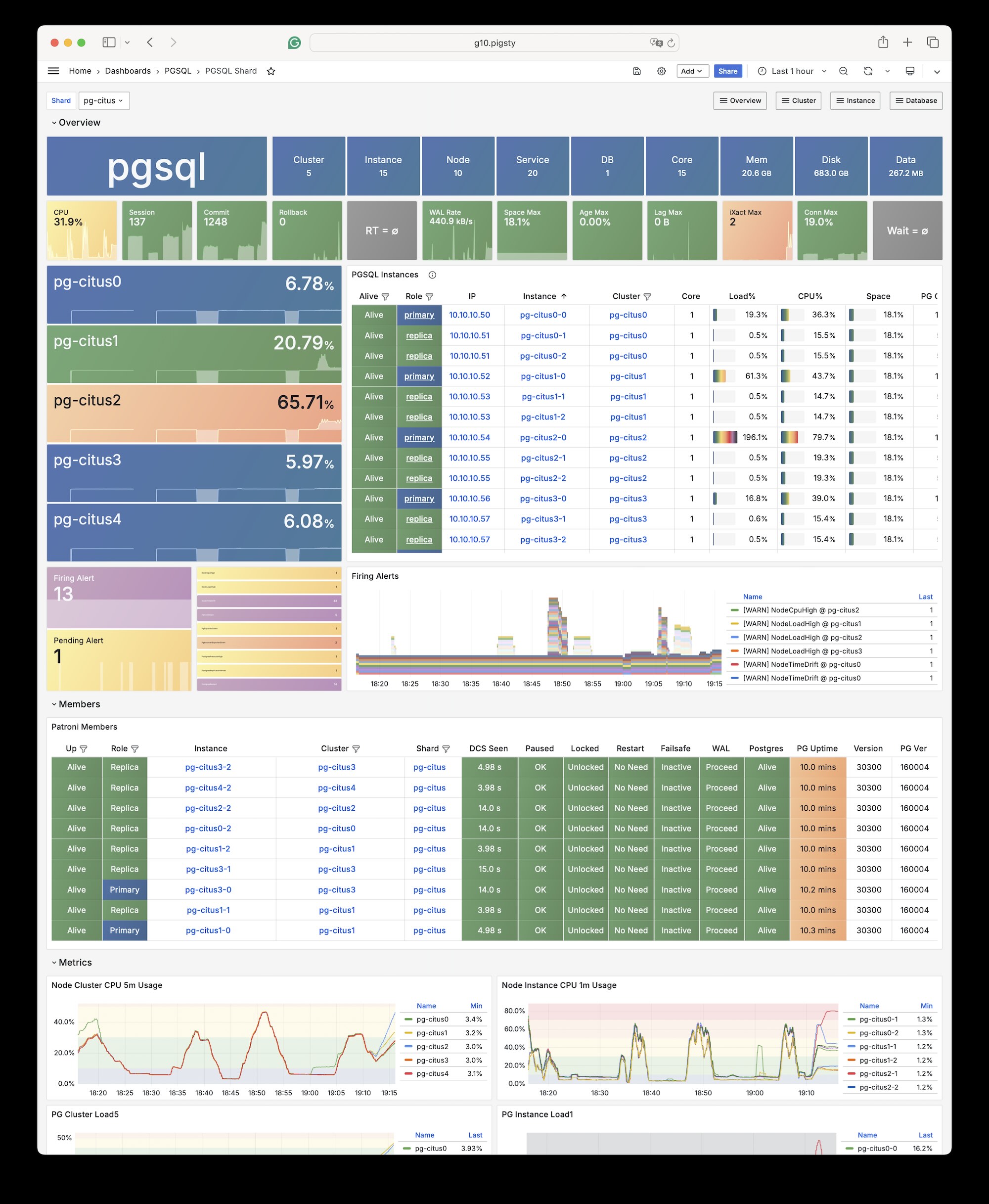
Pigsty natively supports Citus. This is a distributed horizontal scaling extension based on the native PostgreSQL kernel.
Installation
Citus is a PostgreSQL extension plugin that can be installed and enabled on a native PostgreSQL cluster following the standard plugin installation process.
Configuration
To define a citus cluster, you need to specify the following parameters:
pg_modemust be set tocitusinstead of the defaultpgsql- You must define the shard name
pg_shardand shard numberpg_groupon each shard cluster - You must define
pg_primary_dbto specify the database managed by Patroni - If you want to use
postgresfrompg_dbsuinstead of the defaultpg_admin_usernameto execute admin commands, thenpg_dbsu_passwordmust be set to a non-empty plaintext password
Additionally, you need extra hba rules to allow SSL access from localhost and other data nodes.
You can define each Citus cluster as a separate group, like standard PostgreSQL clusters. The current complete template is conf/ha/citus.yml:
You can also specify identity parameters for all Citus cluster members within a single group, as shown in conf/ha/citus.yml:
Usage
You can access any node just like accessing a regular cluster:
By default, changes you make to one Shard only occur on that cluster and are not synchronized to other Shards.
If you want to distribute writes across all Shards, you can use the API functions provided by Citus to mark tables as:
- Distributed tables (automatic partitioning, requires specifying partition key)
- Reference tables (full replication: does not require specifying partition key)
Starting from Citus 11.2, any Citus database node can play the role of coordinator, meaning any primary node can write:
After distributing the tables, you can also access them on other nodes:
For example, a full table scan will show that the execution plan has become a distributed plan:
You can initiate writes from several different primary nodes:
When a node fails, the native high availability support provided by Patroni will promote the standby node and automatically take over.
12 - IvorySQL
IvorySQL is an open-source PostgreSQL kernel fork that aims to provide “Oracle compatibility” based on PG.
Overview
The Pigsty PGSQL repository directly provides IvorySQL 5.4 packages compatible with PostgreSQL 18.4 across the currently supported EL, Debian, Ubuntu, and dual-architecture platforms.
Online installation uses Pigsty’s pgsql repository; the Professional Edition also provides offline delivery for the corresponding platforms.
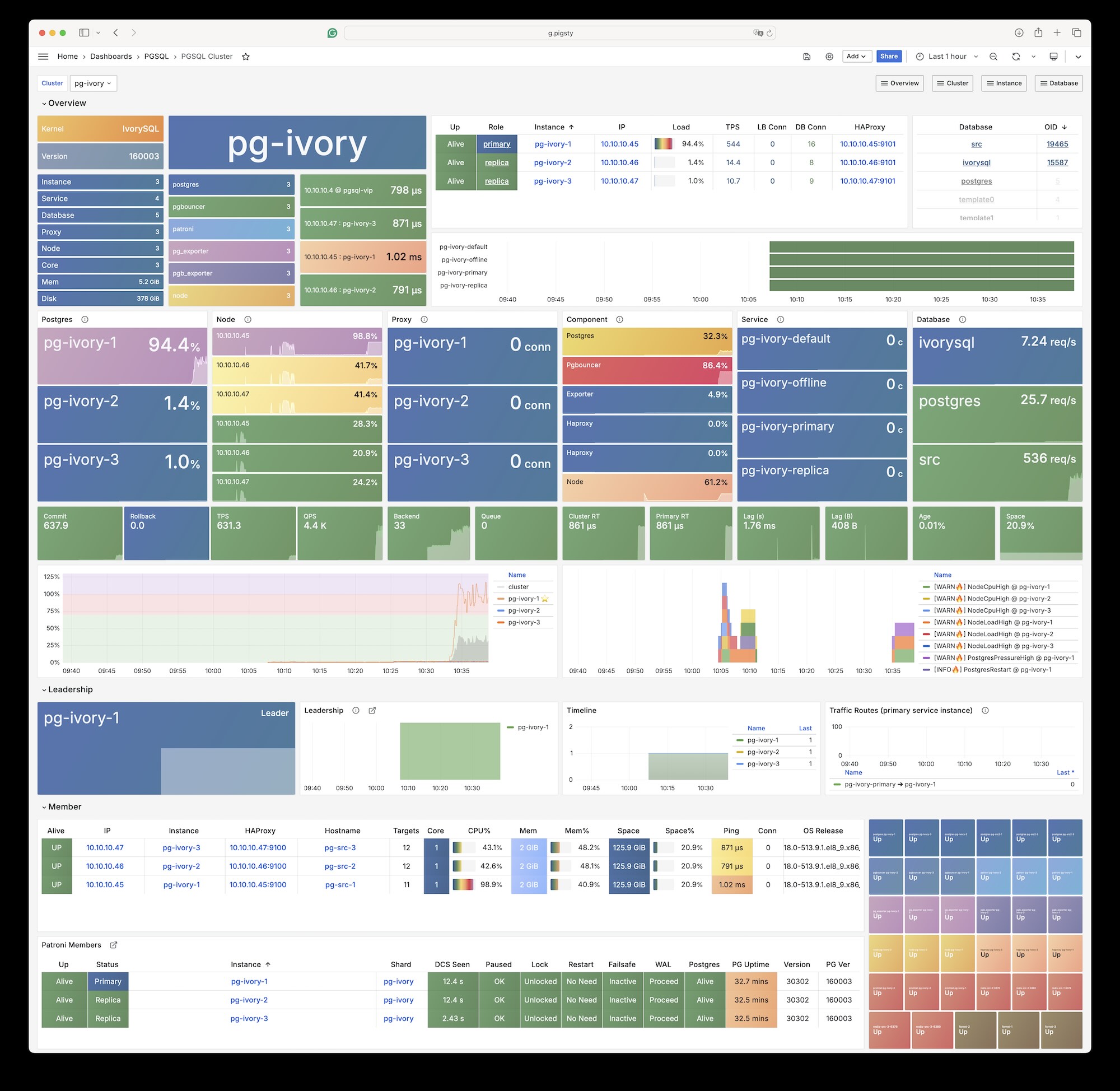
Pigsty’s ivorysql package alias points to IvorySQL 5, compatible with PostgreSQL 18. Real package names are mapped by platform variables under roles/node_id/vars/; for example, EL uses ivorysql5, while Debian/Ubuntu uses ivorysql-5.
The last IvorySQL version supporting EL7 was 3.3, corresponding to PostgreSQL 16.3; the last version based on PostgreSQL 17 is IvorySQL 4.4
Installation
Install with Pigsty’s built-in ivory configuration template:
Configuration
The following parameters need to be configured for IvorySQL database clusters:
When using Oracle compatibility mode, you need to dynamically load the
liboracle_parserextension plugin.
Client Access
IvorySQL 5 is equivalent to PostgreSQL 18, and any client tool compatible with the PostgreSQL wire protocol can access IvorySQL clusters.
Available Extensions
The IvorySQL kernel has 95 available extensions. After removing bundled PG Contrib extensions, the following extra extensions remain:
| Extension | Version | Description |
|---|---|---|
| address_standardizer | 3.5.4 |
Used to parse an address into constituent elements. Generally used to support geocoding address normalization step. |
| address_standardizer_data_us | 3.5.4 |
Address Standardizer US dataset example |
| age | 1.7.0 |
AGE database extension |
| ddlx | 0.31 |
DDL eXtractor functions |
| gb18030_2022 | 1.0 |
support gb18030 2022 with extension |
| http | 1.7 |
HTTP client for PostgreSQL, allows web page retrieval inside the database. |
| ivorysql_ora | 1.0 |
Oracle Compatible extenison on Postgres Database |
| ora_btree_gin | 1.0 |
support for indexing oracle datatypes in GIN |
| ora_btree_gist | 1.0 |
support for oracle indexing common datatypes in GiST |
| pg_bigm | 1.2 |
text similarity measurement and index searching based on bigrams |
| pg_cron | 1.6 |
Job scheduler for PostgreSQL |
| pg_curl | 2.4 |
PostgreSQL cURL allows most curl actions, including data transfer with URL syntax via HTTP, HTTPS, FTP, FTPS, GOPHER, TFTP, SCP, SFTP, SMB, TELNET, DICT, LDAP, LDAPS, FILE, IMAP, SMTP, POP3, RTSP and RTMP |
| pg_get_functiondef | 1.0 |
Get function’s definition |
| pg_hint_plan | 1.8.0 |
optimizer hints for PostgreSQL |
| pg_jieba | 1.1.1 |
a parser for full-text search of Chinese |
| pg_partman | 5.3.1 |
Extension to manage partitioned tables by time or ID |
| pg_show_plans | 2.1 |
show query plans of all currently running SQL statements |
| pg_stat_monitor | 2.3 |
The pg_stat_monitor is a PostgreSQL Query Performance Monitoring tool, based on PostgreSQL contrib module pg_stat_statements. pg_stat_monitor provides aggregated statistics, client information, plan details including plan, and histogram information. |
| pg_textsearch | 0.1.0 |
Full-text search with BM25 ranking |
| pgagent | 4.2 |
A PostgreSQL job scheduler |
| pgaudit | 18.0 |
provides auditing functionality |
| pgroonga | 4.0.4 |
Super fast and all languages supported full text search index based on Groonga |
| pgroonga_database | 4.0.4 |
PGroonga database management module |
| pgrouting | 3.8.0 |
pgRouting Extension |
| plisql | 1.0 |
PL/iSQL procedural language |
| plpgsql_check | 2.8 |
extended check for plpgsql functions |
| postgis | 3.5.4 |
PostGIS geometry and geography spatial types and functions |
| postgis_raster | 3.5.4 |
PostGIS raster types and functions |
| postgis_sfcgal | 3.5.4 |
PostGIS SFCGAL functions |
| postgis_tiger_geocoder | 3.5.4 |
PostGIS tiger geocoder and reverse geocoder |
| postgis_topology | 3.5.4 |
PostGIS topology spatial types and functions |
| redis_fdw | 1.0 |
Foreign data wrapper for querying a Redis server |
| system_stats | 3.0 |
EnterpriseDB system statistics for PostgreSQL |
| vector | 0.8.1 |
vector data type and ivfflat and hnsw access methods |
| zhparser | 2.3 |
a parser for full-text search of Chinese |
Please note that Pigsty does not assume any warranty responsibility for using the IvorySQL kernel. Any issues or requirements encountered when using this kernel should be addressed with the original vendor.
13 - PolarDB PG
Overview
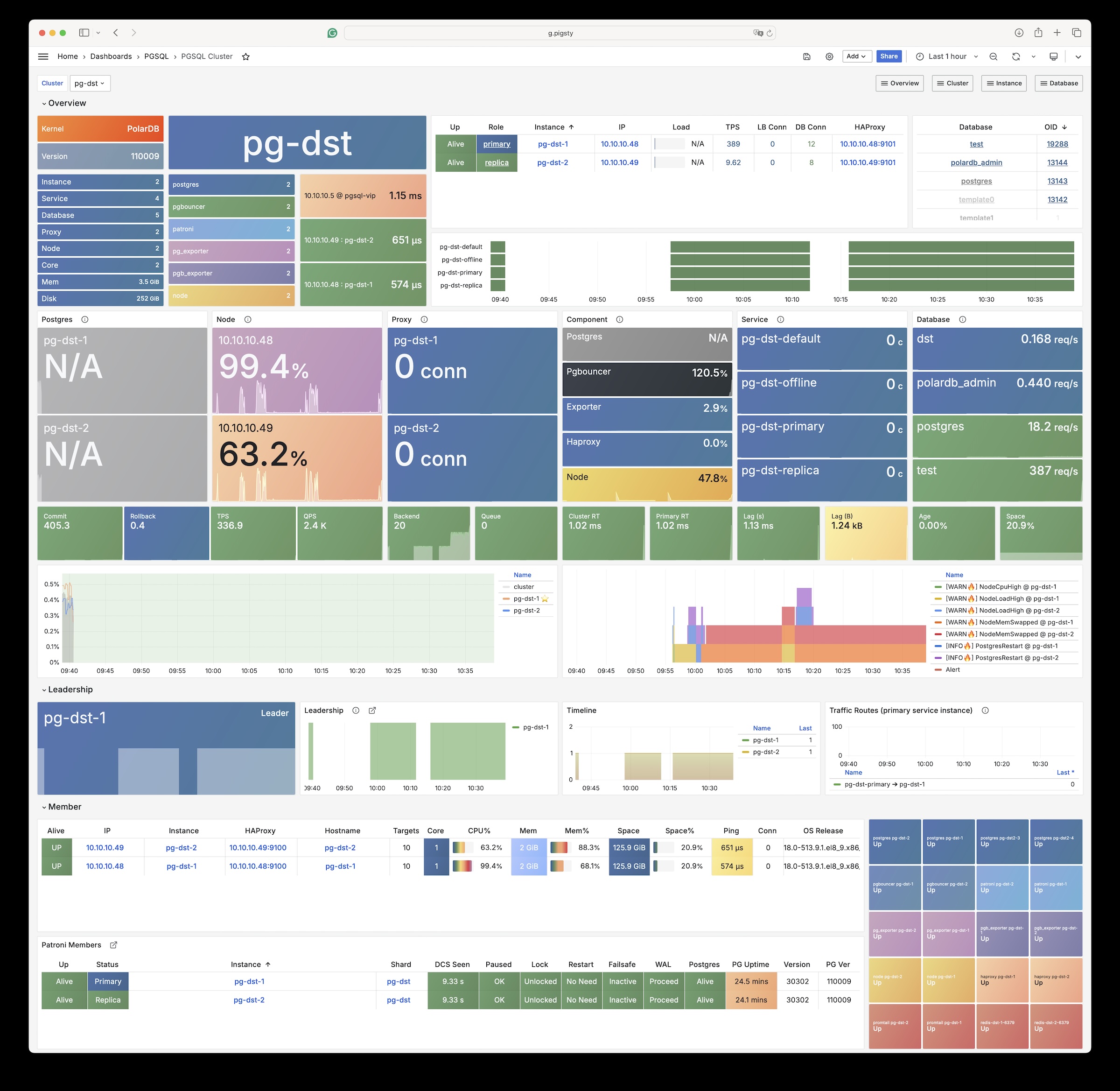
Pigsty allows you to create PostgreSQL clusters with “domestic innovation qualification” credentials using PolarDB!
PolarDB for PostgreSQL now uses PostgreSQL 17 as its base. The polar template, default path, and extension notes in Pigsty have all been updated to PG17. Any client tool compatible with the PostgreSQL wire protocol can access PolarDB clusters.
Pigsty’s PGSQL repository provides PolarDB PG open-source installation packages, but they are not downloaded to the local software repository during Pigsty installation.
Installation
Use the built-in Pigsty template:
Change Summary
Starting with Pigsty v4.4, the PolarDB PG kernel uses packages built and maintained by Pigsty. The main changes are:
| Item | Old docs / old default | Current |
|---|---|---|
| Kernel baseline | PostgreSQL 15 | PostgreSQL 17 |
| Default PolarDB path | /u01/polardb_pg |
/usr/polar-17 |
| Supported architectures | x86_64 |
x86_64, aarch64 |
| Available extensions | Old docs said 61 | pg_available_extensions returns 93; 34 remain after filtering contrib |
| Replication user requirement | replicator must be SUPERUSER |
unchanged |
Configuration
The following parameters need special configuration for PolarDB database clusters:
The default installation directory for the polar kernel has moved to /usr/polar-17. One important difference is that PolarDB PG still requires the replicator replication user to be SUPERUSER, unlike vanilla PostgreSQL.
Available Extensions
The PolarDB PG kernel has 93 available extensions. After removing bundled PG Contrib extensions, the following extra extensions remain:
| Extension | Version | Description |
|---|---|---|
| hll | 2.18 |
type for storing hyperloglog data |
| ip4r | 2.4 |
|
| log_fdw | 1.4 |
foreign-data wrapper for Postgres log file access |
| pase | 0.0.1 |
ant ai similarity search |
| pg_bigm | 1.2 |
text similarity measurement and index searching based on bigrams |
| pg_cron | 1.5 |
Job scheduler for PostgreSQL |
| pg_cron_preload | 1.0 |
polardb pg extend catalog |
| pg_hint_plan | 1.7.0 |
optimizer hints for PostgreSQL |
| pg_jieba | 1.1.0 |
a parser for full-text search of Chinese |
| pg_partman | 5.2.4 |
Extension to manage partitioned tables by time or ID |
| pg_profile | 4.10 |
PostgreSQL load profile repository and report builder |
| pg_repack | 1.5.1-1 |
Reorganize tables in PostgreSQL databases with minimal locks |
| pg_similarity | 1.0 |
support similarity queries |
| pg_squeeze | 1.9 |
A tool to remove unused space from a relation. |
| pg_stat_kcache | 2.3.0 |
Kernel statistics gathering |
| pgaudit | 17.1 |
provides auditing functionality |
| pgtap | 1.3.3 |
Unit testing for PostgreSQL |
| pldbgapi | 1.1 |
server-side support for debugging PL/pgSQL functions |
| polar_advisor | 1.1 |
polar_advisor |
| polar_feature_utils | 1.0 |
PolarDB feature utilization |
| polar_io_stat | 1.0 |
polar io stat in multi dimension |
| polar_monitor | 1.3 |
monitor functions for PolarDB |
| polar_monitor_preload | 1.0 |
examine the polardb information |
| polar_parameter_manager | 1.2 |
Extension to select parameters for manger. |
| polar_proxy_utils | 1.0 |
Extension to provide operations about proxy. |
| polar_resource_manager | 1.0 |
a background process that forcibly frees user session process memory |
| polar_smgrperf | 1.0 |
smgr perf test extension |
| polar_tde_utils | 1.0 |
Internal extension for TDE |
| polar_vfs | 1.0 |
polar virtual file system for different storage |
| polar_worker | 1.1 |
polar_worker |
| prefix | 1.2.0 |
Prefix Range module for PostgreSQL |
| roaringbitmap | 0.5 |
support for Roaring Bitmaps |
| sequential_uuids | 1.0.3 |
generator of sequential UUIDs |
| varbitx | 1.1 |
varbit functions pack |
14 - PolarDB Oracle
Pigsty allows you to create PolarDB for Oracle clusters with “domestic innovation qualification” credentials using PolarDB!
According to the Security and Reliability Evaluation Results Announcement (No. 1, 2023), Appendix 3, Centralized Database. PolarDB v2.0 is an autonomous, controllable, secure, and reliable domestic innovation database.
PolarDB for Oracle is an Oracle-compatible version developed based on PolarDB for PostgreSQL. Both share the same kernel, distinguished by the --compatibility-mode parameter.
We collaborate with the Alibaba Cloud kernel team to provide a complete database solution based on PolarDB v2.0 kernel and Pigsty. Please contact sales for inquiries, or purchase on Alibaba Cloud Marketplace.
The PolarDB for Oracle kernel is currently only available on EL7 (CentOS 7) systems.
Extensions
Currently, the PolarDB 2.0 (Oracle compatible) kernel comes with the following 188 extension plugins:
| name | default_version | comment |
|---|---|---|
| cube | 1.5 | data type for multidimensional cubes |
| ip4r | 2.4 | NULL |
| adminpack | 2.1 | administrative functions for PostgreSQL |
| dict_xsyn | 1.0 | text search dictionary template for extended synonym processing |
| amcheck | 1.4 | functions for verifying relation integrity |
| autoinc | 1.0 | functions for autoincrementing fields |
| hstore | 1.8 | data type for storing sets of (key, value) pairs |
| bloom | 1.0 | bloom access method - signature file based index |
| earthdistance | 1.1 | calculate great-circle distances on the surface of the Earth |
| hstore_plperl | 1.0 | transform between hstore and plperl |
| bool_plperl | 1.0 | transform between bool and plperl |
| file_fdw | 1.0 | foreign-data wrapper for flat file access |
| bool_plperlu | 1.0 | transform between bool and plperlu |
| fuzzystrmatch | 1.1 | determine similarities and distance between strings |
| hstore_plperlu | 1.0 | transform between hstore and plperlu |
| btree_gin | 1.3 | support for indexing common datatypes in GIN |
| hstore_plpython2u | 1.0 | transform between hstore and plpython2u |
| btree_gist | 1.6 | support for indexing common datatypes in GiST |
| hll | 2.17 | type for storing hyperloglog data |
| hstore_plpython3u | 1.0 | transform between hstore and plpython3u |
| citext | 1.6 | data type for case-insensitive character strings |
| hstore_plpythonu | 1.0 | transform between hstore and plpythonu |
| hypopg | 1.3.1 | Hypothetical indexes for PostgreSQL |
| insert_username | 1.0 | functions for tracking who changed a table |
| dblink | 1.2 | connect to other PostgreSQL databases from within a database |
| decoderbufs | 0.1.0 | Logical decoding plugin that delivers WAL stream changes using a Protocol Buffer format |
| intagg | 1.1 | integer aggregator and enumerator (obsolete) |
| dict_int | 1.0 | text search dictionary template for integers |
| intarray | 1.5 | functions, operators, and index support for 1-D arrays of integers |
| isn | 1.2 | data types for international product numbering standards |
| jsonb_plperl | 1.0 | transform between jsonb and plperl |
| jsonb_plperlu | 1.0 | transform between jsonb and plperlu |
| jsonb_plpython2u | 1.0 | transform between jsonb and plpython2u |
| jsonb_plpython3u | 1.0 | transform between jsonb and plpython3u |
| jsonb_plpythonu | 1.0 | transform between jsonb and plpythonu |
| lo | 1.1 | Large Object maintenance |
| log_fdw | 1.0 | foreign-data wrapper for csvlog |
| ltree | 1.2 | data type for hierarchical tree-like structures |
| ltree_plpython2u | 1.0 | transform between ltree and plpython2u |
| ltree_plpython3u | 1.0 | transform between ltree and plpython3u |
| ltree_plpythonu | 1.0 | transform between ltree and plpythonu |
| moddatetime | 1.0 | functions for tracking last modification time |
| old_snapshot | 1.0 | utilities in support of old_snapshot_threshold |
| oracle_fdw | 1.2 | foreign data wrapper for Oracle access |
| oss_fdw | 1.1 | foreign-data wrapper for OSS access |
| pageinspect | 2.1 | inspect the contents of database pages at a low level |
| pase | 0.0.1 | ant ai similarity search |
| pg_bigm | 1.2 | text similarity measurement and index searching based on bigrams |
| pg_freespacemap | 1.2 | examine the free space map (FSM) |
| pg_hint_plan | 1.4 | controls execution plan with hinting phrases in comment of special form |
| pg_buffercache | 1.5 | examine the shared buffer cache |
| pg_prewarm | 1.2 | prewarm relation data |
| pg_repack | 1.4.8-1 | Reorganize tables in PostgreSQL databases with minimal locks |
| pg_sphere | 1.0 | spherical objects with useful functions, operators and index support |
| pg_cron | 1.5 | Job scheduler for PostgreSQL |
| pg_jieba | 1.1.0 | a parser for full-text search of Chinese |
| pg_stat_kcache | 2.2.1 | Kernel statistics gathering |
| pg_stat_statements | 1.9 | track planning and execution statistics of all SQL statements executed |
| pg_surgery | 1.0 | extension to perform surgery on a damaged relation |
| pg_trgm | 1.6 | text similarity measurement and index searching based on trigrams |
| pg_visibility | 1.2 | examine the visibility map (VM) and page-level visibility info |
| pg_wait_sampling | 1.1 | sampling based statistics of wait events |
| pgaudit | 1.6.2 | provides auditing functionality |
| pgcrypto | 1.3 | cryptographic functions |
| pgrowlocks | 1.2 | show row-level locking information |
| pgstattuple | 1.5 | show tuple-level statistics |
| pgtap | 1.2.0 | Unit testing for PostgreSQL |
| pldbgapi | 1.1 | server-side support for debugging PL/pgSQL functions |
| plperl | 1.0 | PL/Perl procedural language |
| plperlu | 1.0 | PL/PerlU untrusted procedural language |
| plpgsql | 1.0 | PL/pgSQL procedural language |
| plpython2u | 1.0 | PL/Python2U untrusted procedural language |
| plpythonu | 1.0 | PL/PythonU untrusted procedural language |
| plsql | 1.0 | Oracle compatible PL/SQL procedural language |
| pltcl | 1.0 | PL/Tcl procedural language |
| pltclu | 1.0 | PL/TclU untrusted procedural language |
| polar_bfile | 1.0 | The BFILE data type enables access to binary file LOBs that are stored in file systems outside Database |
| polar_bpe | 1.0 | polar_bpe |
| polar_builtin_cast | 1.1 | Internal extension for builtin casts |
| polar_builtin_funcs | 2.0 | implement polar builtin functions |
| polar_builtin_type | 1.5 | polar_builtin_type for PolarDB |
| polar_builtin_view | 1.5 | polar_builtin_view |
| polar_catalog | 1.2 | polardb pg extend catalog |
| polar_channel | 1.0 | polar_channel |
| polar_constraint | 1.0 | polar_constraint |
| polar_csn | 1.0 | polar_csn |
| polar_dba_views | 1.0 | polar_dba_views |
| polar_dbms_alert | 1.2 | implement polar_dbms_alert - supports asynchronous notification of database events. |
| polar_dbms_application_info | 1.0 | implement polar_dbms_application_info - record names of executing modules or transactions in the database. |
| polar_dbms_pipe | 1.1 | implements polar_dbms_pipe - package lets two or more sessions in the same instance communicate. |
| polar_dbms_aq | 1.2 | implement dbms_aq - provides an interface to Advanced Queuing. |
| polar_dbms_lob | 1.3 | implement dbms_lob - provides subprograms to operate on BLOBs, CLOBs, and NCLOBs. |
| polar_dbms_output | 1.2 | implement polar_dbms_output - enables you to send messages from stored procedures. |
| polar_dbms_lock | 1.0 | implement polar_dbms_lock - provides an interface to Oracle Lock Management services. |
| polar_dbms_aqadm | 1.3 | polar_dbms_aqadm - procedures to manage Advanced Queuing configuration and administration information. |
| polar_dbms_assert | 1.0 | implement polar_dbms_assert - provide an interface to validate properties of the input value. |
| polar_dbms_metadata | 1.0 | implement polar_dbms_metadata - provides a way for you to retrieve metadata from the database dictionary. |
| polar_dbms_random | 1.0 | implement polar_dbms_random - a built-in random number generator, not intended for cryptography |
| polar_dbms_crypto | 1.1 | implement dbms_crypto - provides an interface to encrypt and decrypt stored data. |
| polar_dbms_redact | 1.0 | implement polar_dbms_redact - provides an interface to mask data from queries by an application. |
| polar_dbms_debug | 1.1 | server-side support for debugging PL/SQL functions |
| polar_dbms_job | 1.0 | polar_dbms_job |
| polar_dbms_mview | 1.1 | implement polar_dbms_mview - enables to refresh materialized views. |
| polar_dbms_job_preload | 1.0 | polar_dbms_job_preload |
| polar_dbms_obfuscation_toolkit | 1.1 | implement polar_dbms_obfuscation_toolkit - enables an application to get data md5. |
| polar_dbms_rls | 1.1 | implement polar_dbms_rls - a fine-grained access control administrative built-in package |
| polar_multi_toast_utils | 1.0 | polar_multi_toast_utils |
| polar_dbms_session | 1.2 | implement polar_dbms_session - support to set preferences and security levels. |
| polar_odciconst | 1.0 | implement ODCIConst - Provide some built-in constants in Oracle. |
| polar_dbms_sql | 1.2 | implement polar_dbms_sql - provides an interface to execute dynamic SQL. |
| polar_osfs_toolkit | 1.0 | osfs library tools and functions extension |
| polar_dbms_stats | 14.0 | stabilize plans by fixing statistics |
| polar_monitor | 1.5 | monitor functions for PolarDB |
| polar_osfs_utils | 1.0 | osfs library utils extension |
| polar_dbms_utility | 1.3 | implement polar_dbms_utility - provides various utility subprograms. |
| polar_parameter_check | 1.0 | kernel extension for parameter validation |
| polar_dbms_xmldom | 1.0 | implement dbms_xmldom and dbms_xmlparser - support standard DOM interface and xml parser object |
| polar_parameter_manager | 1.1 | Extension to select parameters for manager. |
| polar_faults | 1.0.0 | simulate some database faults for end user or testing system. |
| polar_monitor_preload | 1.1 | examine the polardb information |
| polar_proxy_utils | 1.0 | Extension to provide operations about proxy. |
| polar_feature_utils | 1.2 | PolarDB feature utilization |
| polar_global_awr | 1.0 | PolarDB Global AWR Report |
| polar_publication | 1.0 | support polardb pg logical replication |
| polar_global_cache | 1.0 | polar_global_cache |
| polar_px | 1.0 | Parallel Execution extension |
| polar_serverless | 1.0 | polar serverless extension |
| polar_resource_manager | 1.0 | a background process that forcibly frees user session process memory |
| polar_sys_context | 1.1 | implement polar_sys_context - returns the value of parameter associated with the context namespace at the current instant. |
| polar_gpc | 1.3 | polar_gpc |
| polar_tde_utils | 1.0 | Internal extension for TDE |
| polar_gtt | 1.1 | polar_gtt |
| polar_utl_encode | 1.2 | implement polar_utl_encode - provides functions that encode RAW data into a standard encoded format |
| polar_htap | 1.1 | extension for PolarDB HTAP |
| polar_htap_db | 1.0 | extension for PolarDB HTAP database level operation |
| polar_io_stat | 1.0 | polar io stat in multi dimension |
| polar_utl_file | 1.0 | implement utl_file - support PL/SQL programs can read and write operating system text files |
| polar_ivm | 1.0 | polar_ivm |
| polar_sql_mapping | 1.2 | Record error sqls and mapping them to correct one |
| polar_stat_sql | 1.0 | Kernel statistics gathering, and sql plan nodes information gathering |
| tds_fdw | 2.0.2 | Foreign data wrapper for querying a TDS database (Sybase or Microsoft SQL Server) |
| xml2 | 1.1 | XPath querying and XSLT |
| polar_upgrade_catalogs | 1.1 | Upgrade catalogs for old version instance |
| polar_utl_i18n | 1.1 | polar_utl_i18n |
| polar_utl_raw | 1.0 | implement utl_raw - provides SQL functions for manipulating RAW datatypes. |
| timescaledb | 2.9.2 | Enables scalable inserts and complex queries for time-series data |
| polar_vfs | 1.0 | polar virtual file system for different storage |
| polar_worker | 1.0 | polar_worker |
| postgres_fdw | 1.1 | foreign-data wrapper for remote PostgreSQL servers |
| refint | 1.0 | functions for implementing referential integrity (obsolete) |
| roaringbitmap | 0.5 | support for Roaring Bitmaps |
| tsm_system_time | 1.0 | TABLESAMPLE method which accepts time in milliseconds as a limit |
| vector | 0.5.0 | vector data type and ivfflat and hnsw access methods |
| rum | 1.3 | RUM index access method |
| unaccent | 1.1 | text search dictionary that removes accents |
| seg | 1.4 | data type for representing line segments or floating-point intervals |
| sequential_uuids | 1.0.2 | generator of sequential UUIDs |
| uuid-ossp | 1.1 | generate universally unique identifiers (UUIDs) |
| smlar | 1.0 | compute similarity of any one-dimensional arrays |
| varbitx | 1.1 | varbit functions pack |
| sslinfo | 1.2 | information about SSL certificates |
| tablefunc | 1.0 | functions that manipulate whole tables, including crosstab |
| tcn | 1.0 | Triggered change notifications |
| zhparser | 1.0 | a parser for full-text search of Chinese |
| address_standardizer | 3.3.2 | Ganos PostGIS address standardizer |
| address_standardizer_data_us | 3.3.2 | Ganos PostGIS address standardizer data us |
| ganos_fdw | 6.0 | Ganos Spatial FDW extension for POLARDB |
| ganos_geometry | 6.0 | Ganos geometry lite extension for POLARDB |
| ganos_geometry_pyramid | 6.0 | Ganos Geometry Pyramid extension for POLARDB |
| ganos_geometry_sfcgal | 6.0 | Ganos geometry lite sfcgal extension for POLARDB |
| ganos_geomgrid | 6.0 | Ganos geometry grid extension for POLARDB |
| ganos_importer | 6.0 | Ganos Spatial importer extension for POLARDB |
| ganos_networking | 6.0 | Ganos networking |
| ganos_pointcloud | 6.0 | Ganos pointcloud extension For POLARDB |
| ganos_pointcloud_geometry | 6.0 | Ganos_pointcloud LIDAR data and ganos_geometry data for POLARDB |
| ganos_raster | 6.0 | Ganos raster extension for POLARDB |
| ganos_scene | 6.0 | Ganos scene extension for POLARDB |
| ganos_sfmesh | 6.0 | Ganos surface mesh extension for POLARDB |
| ganos_spatialref | 6.0 | Ganos spatial reference extension for POLARDB |
| ganos_trajectory | 6.0 | Ganos trajectory extension for POLARDB |
| ganos_vomesh | 6.0 | Ganos volume mesh extension for POLARDB |
| postgis_tiger_geocoder | 3.3.2 | Ganos PostGIS tiger geocoder |
| postgis_topology | 3.3.2 | Ganos PostGIS topology |
15 - PostgresML
PostgresML is a PostgreSQL extension that supports the latest large language models (LLM), vector operations, classical machine learning, and traditional Postgres application workloads.
PostgresML (pgml) is a PostgreSQL extension written in Rust. You can run standalone Docker images, but this documentation is not a docker-compose template introduction, for reference only.
PostgresML officially supports Ubuntu 22.04, but we also maintain RPM versions for EL 8/9, if you don’t need CUDA and NVIDIA-related features.
You need internet access on database nodes to download Python dependencies from PyPI and models from HuggingFace.
Because the company behind it has ceased operations.
Configuration
PostgresML is an extension written in Rust. Pigsty maintains prebuilt packages for PG14-17 on EL8/EL9 and Debian/Ubuntu platforms.
Creating a New Cluster
PostgresML 2.10.0 is available for PostgreSQL 14-17. The example below uses PG17; if you use PG14-16, change pg_version to the corresponding major version.
Pigsty resolves the pgml package alias to the platform-specific package name: pgml_$v on EL and postgresql-$v-pgml on Debian/Ubuntu. You also need to add pgml to pg_libs.
Enabling on an Existing Cluster
To enable pgml on an existing cluster, you can install it using Ansible’s package module:
Python Dependencies
You also need to install PostgresML’s Python dependencies on cluster nodes. Official tutorial: Installation Guide
Install Python and PIP
Ensure python3, pip, and venv are installed:
For EL 8 / EL9 and compatible distributions, you can use python3.11:
For users in mainland China, we recommend using Tsinghua University’s PyPI mirror.
Install Dependencies
Create a Python virtual environment and use pip to install dependencies from requirements.txt and requirements-xformers.txt.
If you’re using EL 8/9, replace
python3withpython3.11in the following commands.
Enable PostgresML
After installing the pgml extension and Python dependencies on all cluster nodes, you can enable pgml on the PostgreSQL cluster.
Use the patronictl command to configure the cluster, add pgml to shared_preload_libraries, and specify your virtual environment directory in pgml.venv:
Then restart the database cluster and create the extension using SQL commands:
If everything is normal, you should see output similar to the following:
Done! For more details, please refer to the official PostgresML documentation: https://postgresml.org/docs/guides/use-cases/
16 - Greenplum
Pigsty supports deploying Greenplum clusters and its derivative distribution YMatrixDB, and provides the capability to integrate existing Greenplum deployments into Pigsty monitoring.
Overview
Greenplum / YMatrix cluster deployment capabilities are only available in the professional/enterprise editions and are not currently open source.
Installation
Pigsty provides installation packages for Greenplum 6 (@el7) and Greenplum 7 (@el8). Open source users can install and configure them manually.
Configuration
To define a Greenplum cluster, you need to use pg_mode = gpsql and additional identity parameters pg_shard and gp_role.
Additionally, PG Exporter requires extra connection parameters to connect to Greenplum Segment instances for metric collection.
17 - Neon
Neon adopts a storage and compute separation architecture, providing seamless autoscaling, scale to zero, and unique database branching capabilities.
Neon official website: https://neon.tech/
Neon binaries are currently too large to include in the open-source package set. This support path remains in pilot stage; contact Pigsty sales if you need it.