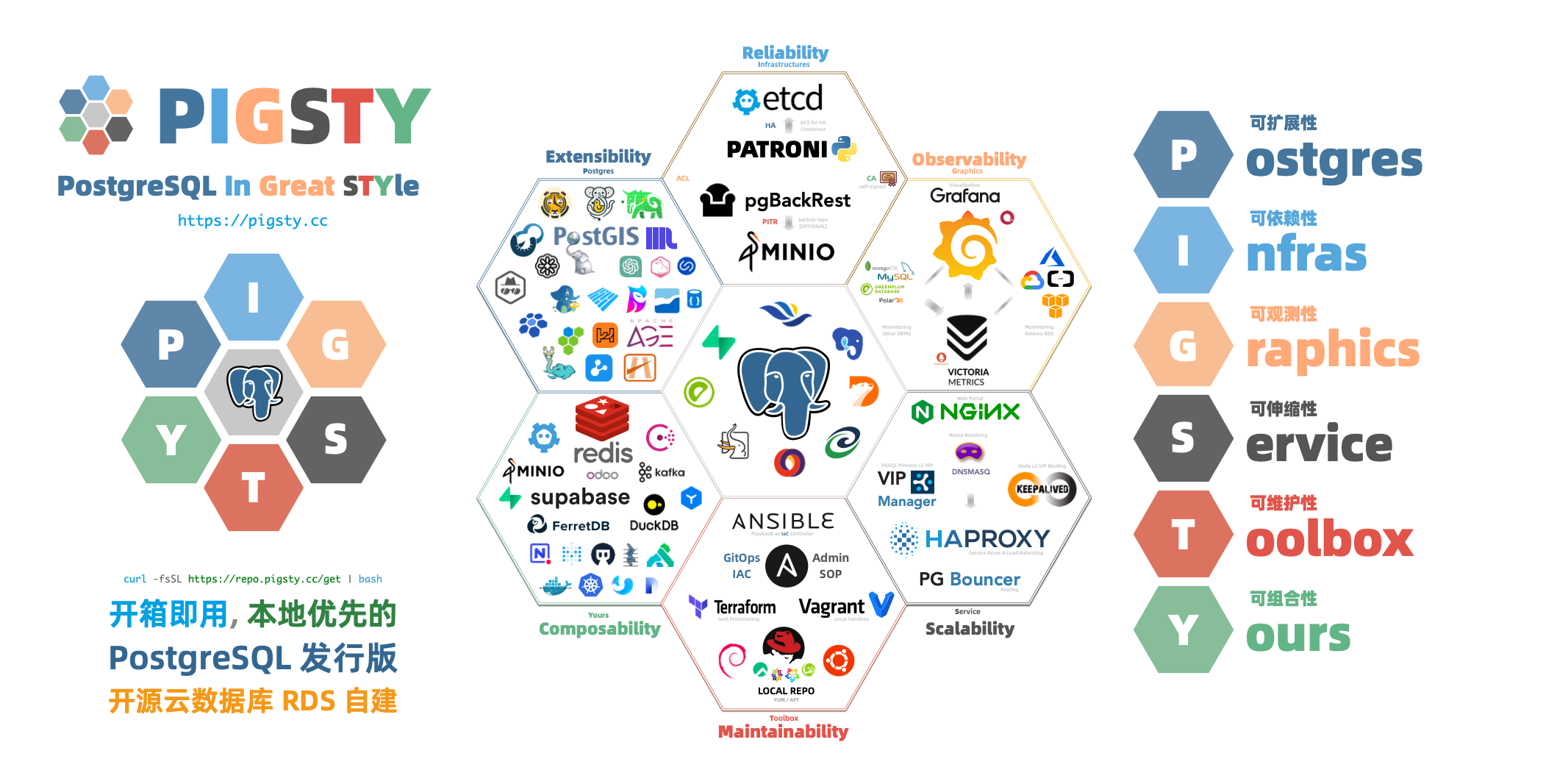
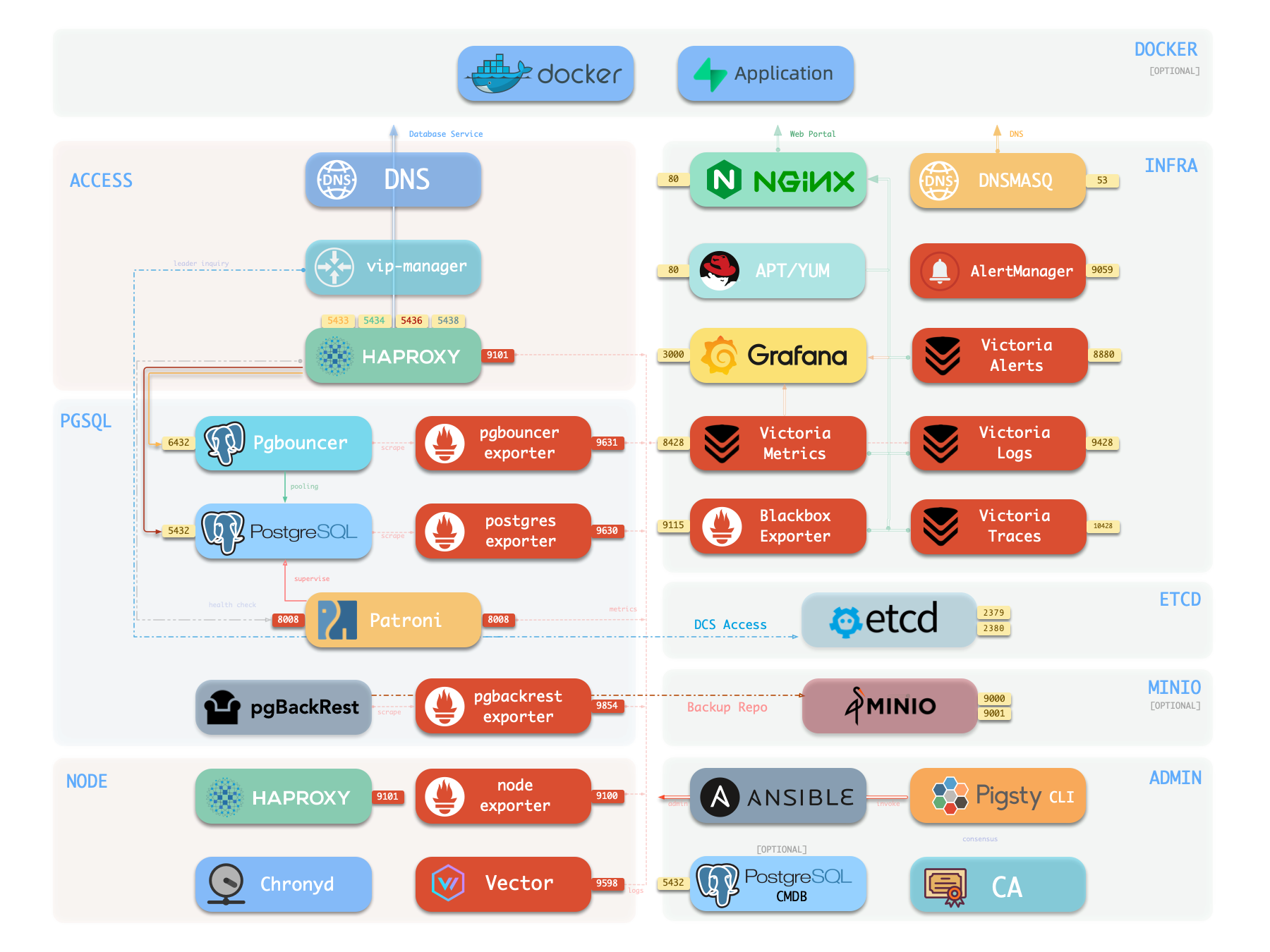
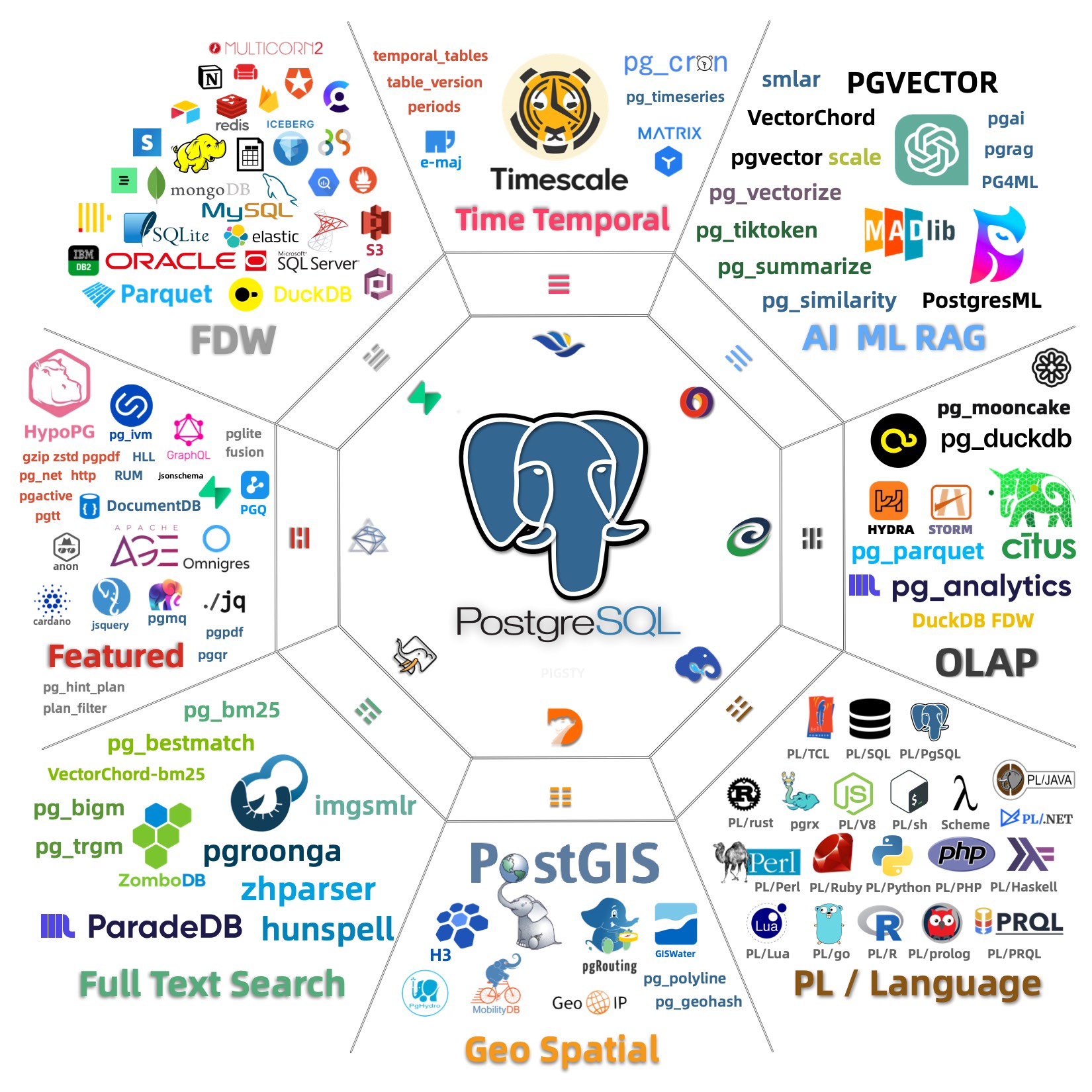
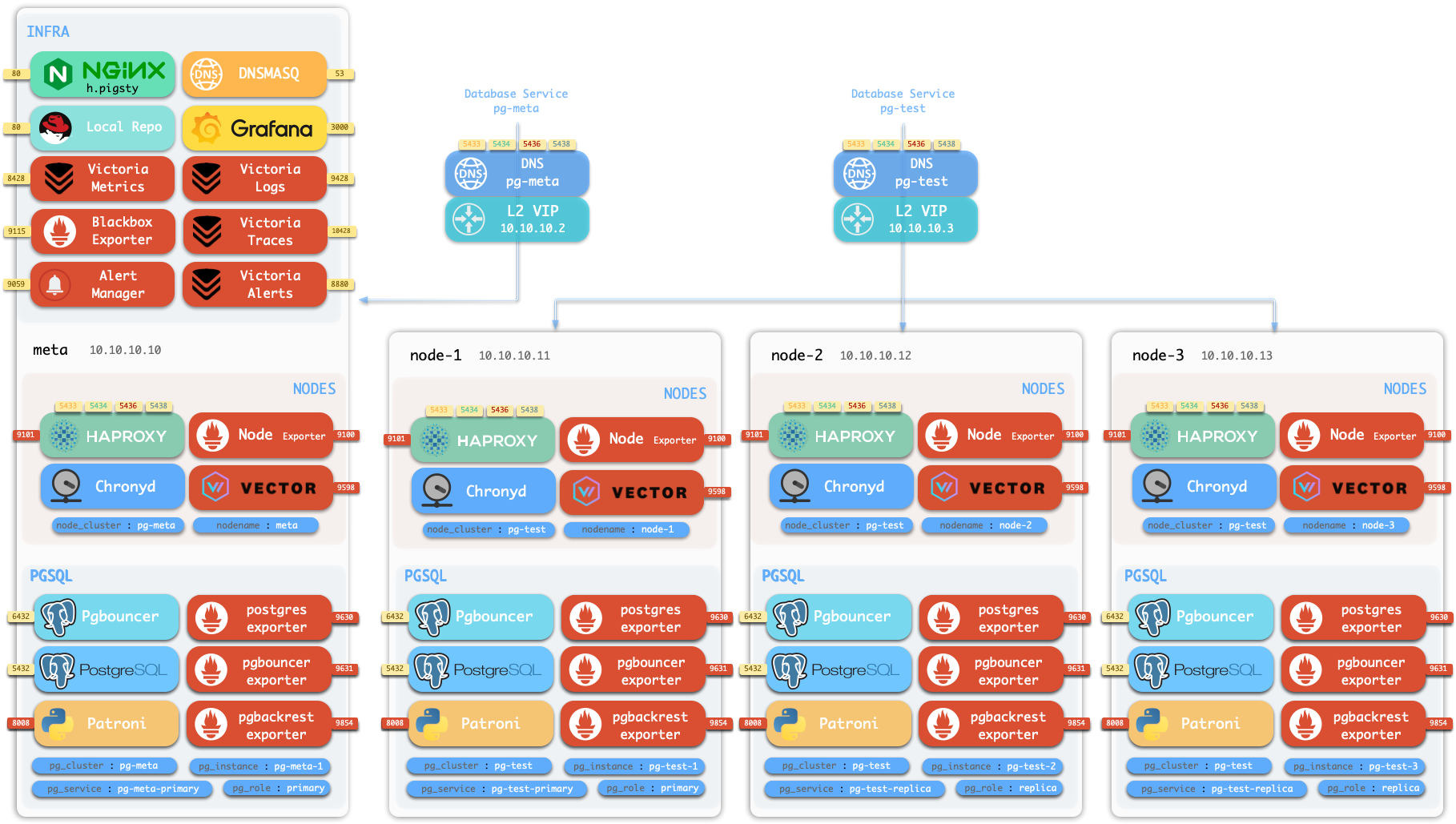
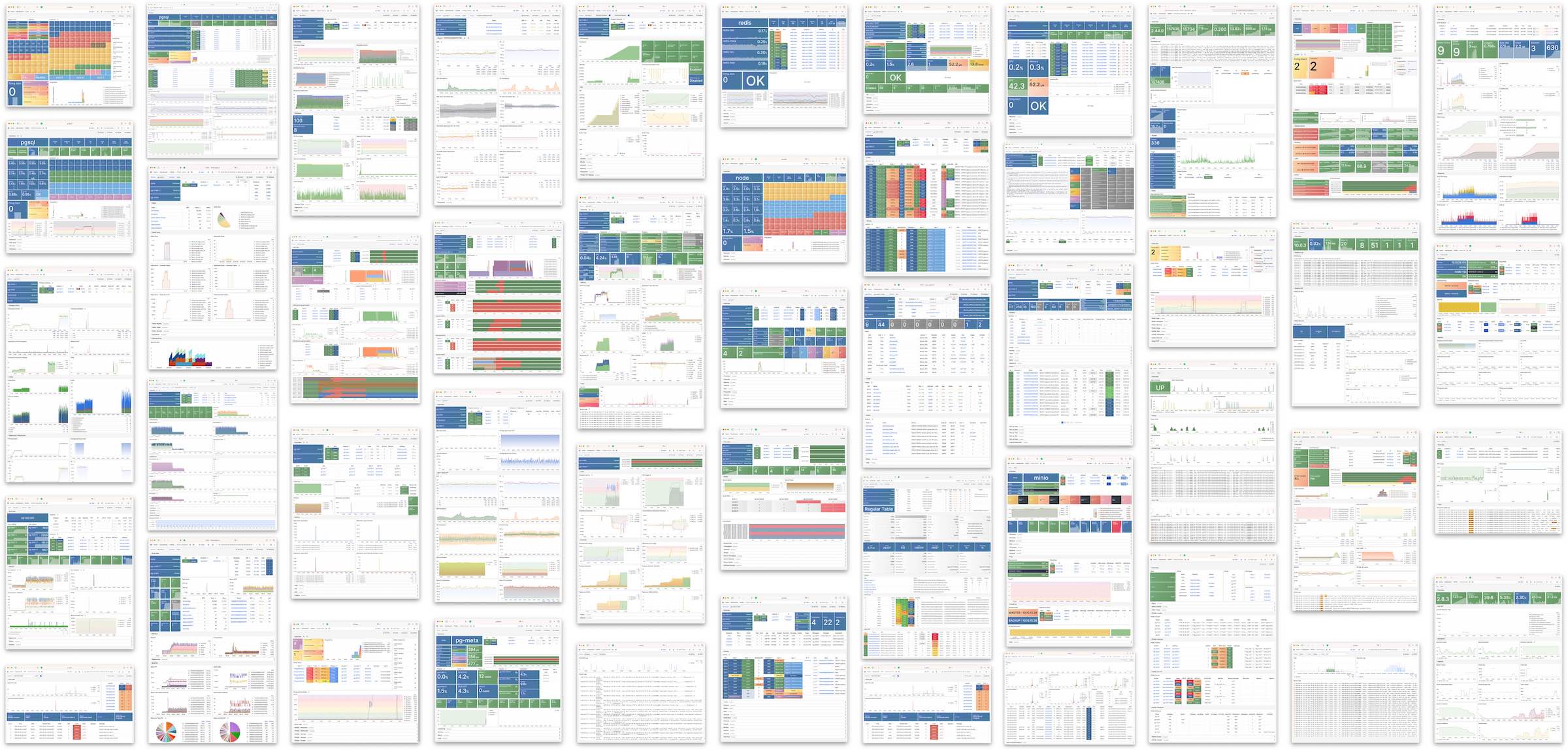
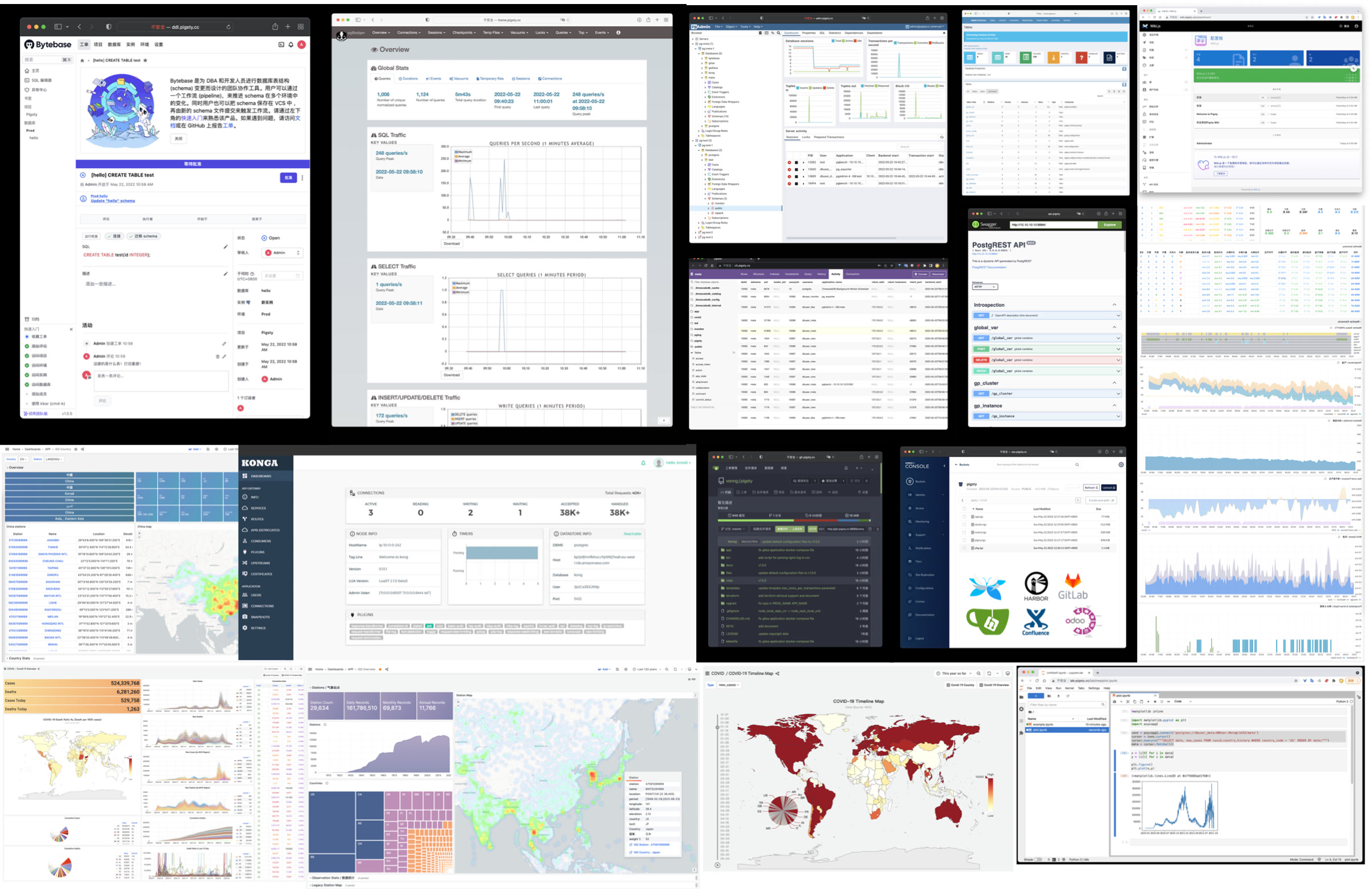
Observability: Based on Prometheus & Grafana modern observability stack, providing stunning monitoring best practices. Modular design, can be used independently: Gallery & Demo.
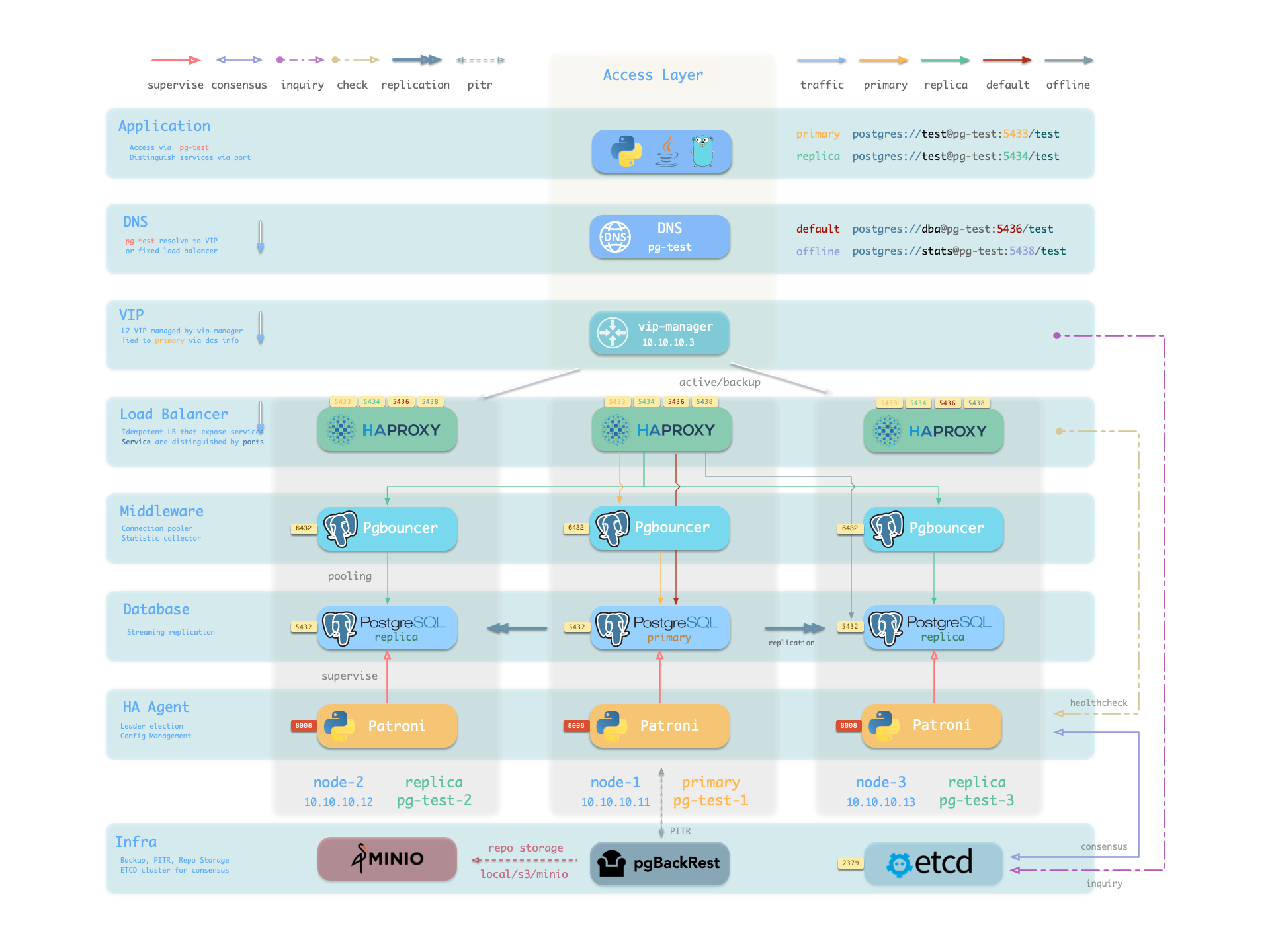
Availability: Deliver stable, reliable, auto-routed, transaction-pooled, read-write separated high-performance database services, with flexible access modes via HAProxy, Pgbouncer, and VIP.
Flexible Modular Architecture: Compose Redis, Etcd, and Silo object-storage modules with PostgreSQL modes such as Mongo; monitor existing RDS, hosts, and databases independently.
Stunning Observability: Based on modern observability stack Prometheus/Grafana, providing stunning, unparalleled database observability capabilities.
Battle-Tested Reliability: Self-healing high-availability architecture: automatic failover on hardware failure, seamless traffic switching. With auto-configured PITR as safety net for accidental data deletion!
Easy to Use and Maintain: Declarative API, GitOps ready, foolproof operation, Database/Infra-as-Code and management SOPs encapsulating management complexity!
Solid Security Practices: HBA, ACL, TLS, backup, logging, and host-firewall foundations, with explicit default boundaries and production hardening requirements.
Broad Application Scenarios: Low-code data application development, or use preset Docker Compose templates to spin up massive software using PostgreSQL with one click!
Open-Source Free Software: Own better database services at less than 1/10 the cost of cloud databases! Truly “own” your data and achieve autonomy!
PostgreSQL integrates ecosystem tools and best practices:
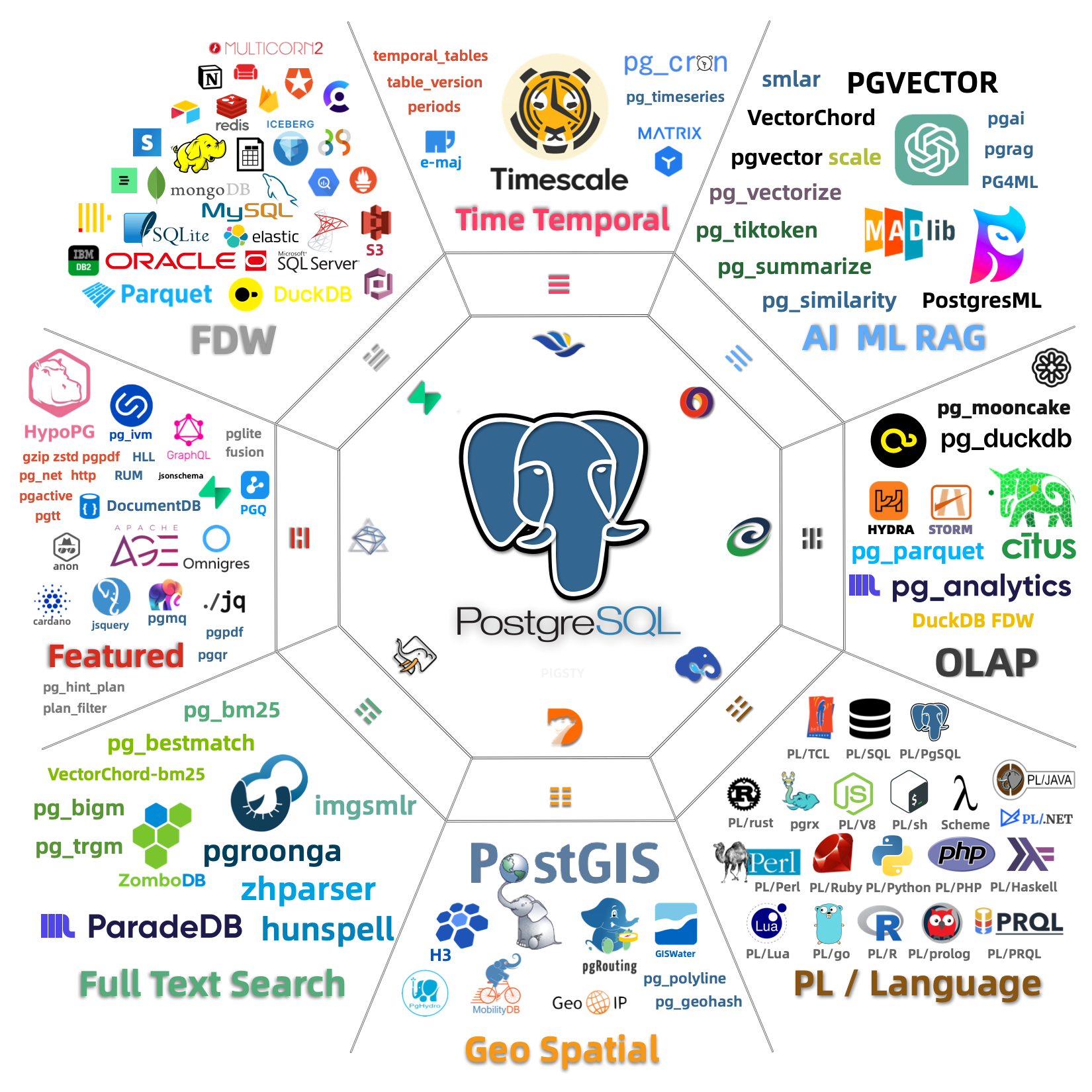
Out-of-the-box PostgreSQL distribution, deeply integrating 575 packaged extensions for geospatial, time-series, distributed, graph, vector, search, and AI!
Runs on bare operating systems without container support, supporting mainstream operating systems: EL 8/9/10, Ubuntu 22.04/24.04/26.04, and Debian 12/13.
Based on patroni, haproxy, and etcd, creating a self-healing high-availability architecture: automatic failover on hardware failure, seamless traffic switching.
Combines pgBackRest with optional Silo object storage to provide out-of-the-box point-in-time recovery (PITR), protecting against software defects and accidental data deletion.
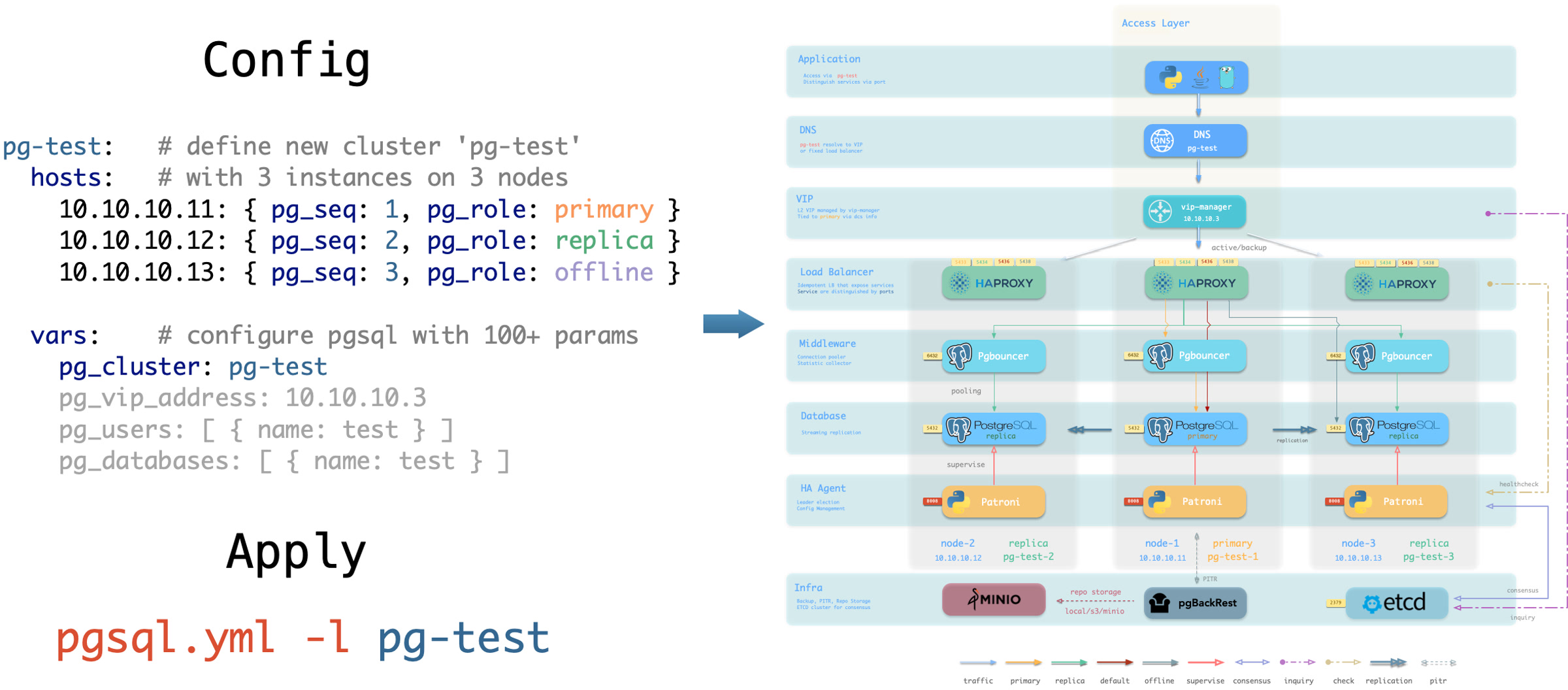
Based on Ansible providing declarative APIs to abstract complexity, greatly simplifying daily operations management in a Database-as-Code manner.
Pigsty has broad applications, can be used as complete application runtime, develop demo data/visualization applications, and massive software using PG can be spun up with Docker templates.
Provides Vagrant-based local development and testing sandbox environment, and Terraform-based cloud auto-deployment solutions, keeping development, testing, and production environments consistent.
Get production-grade PostgreSQL database services locally immediately!
PostgreSQL is a near-perfect database kernel, but it needs more tools and systems to become a good enough database service (RDS). Pigsty helps PostgreSQL make this leap.
Pigsty solves various challenges you’ll encounter when using PostgreSQL: kernel extension installation, connection pooling, load balancing, service access, high availability / automatic failover, log collection, metrics monitoring, alerting, backup recovery, PITR, access control, parameter tuning, security encryption, certificate issuance, NTP, DNS, parameter tuning, configuration management, CMDB, management playbooks… You no longer need to worry about these details!
Pigsty supports PostgreSQL 14 ~ 18 mainline kernels and other compatible forks, running on EL / Debian / Ubuntu and compatible OS distributions, available on x86_64 and ARM64 chip architectures, without container support required.
Besides database kernels and many out-of-the-box extension plugins, Pigsty also provides complete infrastructure and runtime required for database services, as well as local sandbox / production environment / cloud IaaS auto-deployment solutions.
Pigsty can bootstrap an entire environment from bare metal with one click, reaching the last mile of software delivery. Ordinary developers and operations engineers can quickly get started and manage databases part-time, building enterprise-grade RDS services without database experts!
Rich Extensions
Hyper-converged multi-modal, use PostgreSQL for everything, one PG to replace all databases!
PostgreSQL’s soul lies in its rich extension ecosystem, and Pigsty uniquely deeply integrates 575 extensions from the PostgreSQL ecosystem, providing you with an out-of-the-box hyper-converged multi-modal database!
Extensions can create synergistic effects, producing 1+1 far greater than 2 results.
You can use PostGIS for geospatial data, TimescaleDB for time-series/event stream data analysis, and Citus to upgrade it in-place to a distributed geospatial-temporal database;
You can use PGVector to store and search AI embeddings, ParadeDB for ElasticSearch-level full-text search, and simultaneously use precise SQL, full-text search, and fuzzy vector for hybrid search.
You can also achieve dedicated OLAP database/data lakehouse analytical performance through pg_duckdb, pg_mooncake and other analytical extensions.
Using PostgreSQL as a single component to replace MySQL, Kafka, ElasticSearch, MongoDB, and big data analytics stacks has become a best practice — a single database choice can significantly reduce system complexity, greatly improve development efficiency and agility, achieving remarkable software/hardware and development/operations cost reduction and efficiency improvement.
Components in Pigsty are abstracted as independently deployable modules, which can be freely combined to address varying requirements. The INFRA module comes with a complete modern monitoring stack, while the NODE module tunes nodes to desired state and brings them under management.
Installing the PGSQL module on multiple nodes automatically forms a high-availability database cluster based on primary-replica replication, while the ETCD module provides consensus and metadata storage for database high availability.
Beyond these four core modules, Pigsty also provides a series of optional feature modules: The MINIO module can deploy Silo to provide local object storage and serve as a centralized database backup repository.
The REDIS module can provide auxiliary services for databases in standalone primary-replica, sentinel, or native cluster modes. The DOCKER module can be used to spin up stateless application software.
Additionally, Pigsty provides PG-compatible / derivative kernel support. You can use Babelfish for MS SQL Server compatibility, IvorySQL for Oracle compatibility,
OpenHaloDB for MySQL compatibility, and OrioleDB for ultimate OLTP performance.
Furthermore, you can use PostgreSQL Mongo mode for MongoDB compatibility, Supabase for Firebase compatibility, and PolarDB to meet domestic compliance requirements.
Message queues are covered by the KAFKA module, which deploys Kafka 4.x dynamic KRaft clusters.
More professional/pilot modules will be continuously introduced to Pigsty, such as GPSQL, DUCKDB, TIGERBEETLE, KUBERNETES, CONSUL, GREENPLUM, CLOUDBERRY, MYSQL, …
Stunning Observability
Using modern open-source observability stack, providing unparalleled monitoring best practices!
Pigsty provides best practices for monitoring based on the open-source Grafana / Prometheus modern observability stack: Grafana for visualization, VictoriaMetrics for metrics collection, VictoriaLogs for log collection and querying, Alertmanager for alert notifications. Blackbox Exporter for checking service availability. The entire system is also designed for one-click deployment as the out-of-the-box INFRA module.
Pigsty automatically monitors every managed component: host nodes, HAProxy load balancers, PostgreSQL databases, PgBouncer connection pools, Etcd metadata stores, Redis-compatible caches, Silo object storage, and the monitoring infrastructure itself. Grafana dashboards and preset alert rules provide immediate operational visibility. The same stack can also monitor applications, existing database instances, and cloud RDS services.
Whether for failure analysis or slow query optimization, capacity assessment or resource planning, Pigsty provides comprehensive data support, truly achieving data-driven operations. In Pigsty, over three thousand types of monitoring metrics are used to describe all aspects of the entire system, and are further processed, aggregated, analyzed, refined, and presented in intuitive visualization modes. From global overview dashboards to CRUD details of individual objects (tables, indexes, functions) in a database instance, everything is visible at a glance. You can drill down, roll up, or jump horizontally freely, browsing current system status and historical trends, and predicting future evolution.
Additionally, Pigsty’s monitoring system module can be used independently — to monitor existing host nodes and database instances, or cloud RDS services. With just one connection string and one command, you can get the ultimate PostgreSQL observability experience.
Out-of-the-box high availability and point-in-time recovery capabilities ensure your database is rock-solid!
For table/database drops caused by software defects or human error, Pigsty provides out-of-the-box PITR point-in-time recovery capability, enabled by default without additional configuration. As long as storage space allows, base backups and WAL archiving based on pgBackRest let you quickly return to any point within the recovery window. You can use local directories/disks, Silo deployed by the MINIO module, or external S3-compatible object-storage services to retain longer recovery windows, according to your budget.
Pigsty provides a high-availability self-healing architecture based on Patroni, etcd, and HAProxy. When the node, network, quorum, and synchronous-replica assumptions hold, it can fail over the primary automatically. Actual RTO and RPO depend on replication mode, failure type, timeout settings, and client reconnection behavior.
Pigsty includes built-in HAProxy load balancers for automatic traffic switching, providing DNS/VIP/LVS and other access methods for clients. Failover and active switchover are almost imperceptible to the business side except for brief interruptions, and applications don’t need to modify connection strings or restart. The minimal maintenance window requirements bring great flexibility and convenience: you can perform rolling maintenance and upgrades on the entire cluster without application coordination. The feature that hardware failures can wait until the next day to handle lets developers, operations, and DBAs sleep well.
Many large organizations and core institutions have been using Pigsty in production for extended periods. The largest deployment has 25K CPU cores and 200+ PostgreSQL ultra-large instances; in this deployment case, dozens of hardware failures and various incidents occurred over six to seven years, DBAs changed several times, but still maintained availability higher than 99.999%.
Easy to Use and Maintain
Infra as Code, Database as Code, declarative APIs encapsulate database management complexity.
Pigsty provides services through declarative interfaces, elevating system controllability to a new level: users tell Pigsty “what kind of database cluster I want” through configuration inventories, without worrying about how to do it. In effect, this is similar to CRDs and Operators in K8S, but Pigsty can be used for databases and infrastructure on any node: whether containers, virtual machines, or physical machines.
Whether creating/destroying clusters, adding/removing replicas, or creating new databases/users/services/extensions/whitelist rules, you only need to modify the configuration inventory and run the idempotent playbooks provided by Pigsty, and Pigsty adjusts the system to your desired state.
Users don’t need to worry about configuration details — Pigsty automatically tunes based on machine hardware configuration. You only need to care about basics like cluster name, how many instances on which machines, what configuration template to use: transaction/analytics/critical/tiny — developers can also self-serve. But if you’re willing to dive into the rabbit hole, Pigsty also provides rich and fine-grained control parameters to meet the demanding customization needs of the most meticulous DBAs.
Beyond that, Pigsty’s own installation and deployment is also one-click foolproof, with all dependencies pre-packaged, requiring no internet access during installation. The machine resources needed for installation can also be automatically obtained through Vagrant or Terraform templates, allowing you to spin up a complete Pigsty deployment from scratch on a local laptop or cloud VM in about ten minutes. The local sandbox environment can run on a 1-core 2GB micro VM, providing the same functional simulation as production environments, usable for development, testing, demos, and learning.
Solid Security Practices
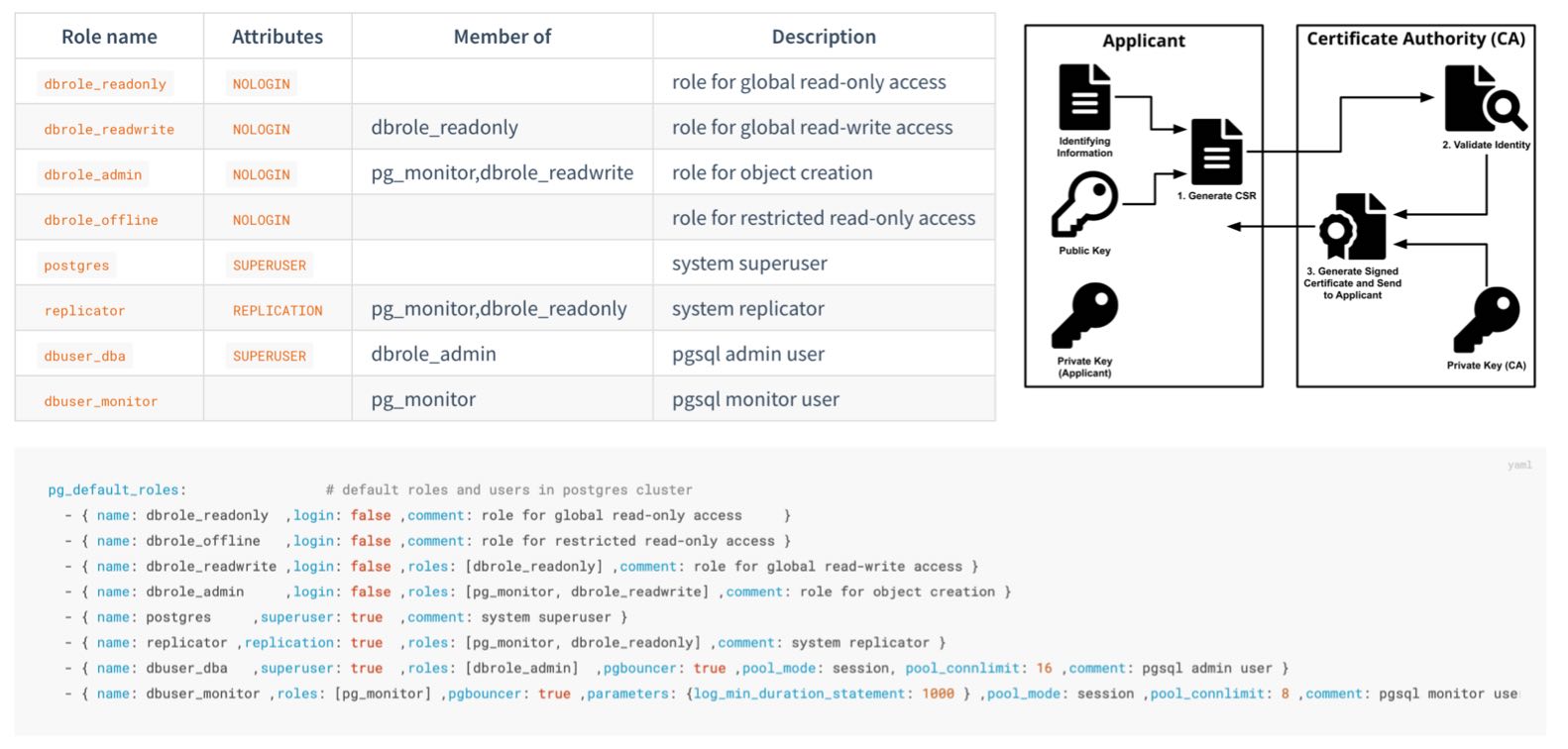
Pigsty provides the security foundations required for database deployment: layered HBA, built-in roles and default privileges, SCRAM-SHA-256, page checksums, a local CA, component certificates, backup, PITR, centralized logs, and firewall configuration.
The defaults target development, testing, and demonstrations on a trusted intranet. Production deployments must replace public credentials, review network boundaries, enforce TLS where required, configure server-certificate verification, and establish backup recovery, privilege review, and incident-response processes.
Security and Compliance documents each mechanism’s default state and boundary. Security Considerations provides production hardening guidance, and Compliance maps relevant controls to MLPS and SOC 2. Whether a deployment meets a specific requirement depends on scope, organizational process, continuous evidence, and the auditor’s conclusion.
Broad Application Scenarios
Use preset Docker templates to spin up massive software using PostgreSQL with one click!
In various data-intensive applications, the database is often the trickiest part. For example, the core difference between GitLab Enterprise and Community Edition is the underlying PostgreSQL database monitoring and high availability. If you already have a good enough local PG RDS, you can refuse to pay for software’s homemade database components.
Pigsty provides the Docker module and many out-of-the-box Compose templates. You can use Pigsty-managed high-availability PostgreSQL (as well as Redis and Silo) as backend storage, spinning up these software in stateless mode with one click:
GitLab, Gitea, Wiki.js, NocoDB, Odoo, Jira, Confluence, Harbor, Mastodon, Discourse, KeyCloak, Mattermost, etc. If your application needs a reliable PostgreSQL database, Pigsty is perhaps the simplest way to get one.
Pigsty also provides application development toolsets closely related to PostgreSQL: PGAdmin4, PGWeb, ByteBase, PostgREST, Kong, as well as EdgeDB, FerretDB, Supabase — these “upper-layer databases” using PostgreSQL as storage.
More wonderfully, you can build interactive data applications quickly in a low-code manner based on the Grafana and Postgres built into Pigsty, and even use Pigsty’s built-in ECharts panels to create more expressive interactive visualization works.
Pigsty provides a powerful runtime for your AI applications. Your agents can leverage PostgreSQL and the powerful capabilities of the observability world in this environment to quickly build data-driven intelligent agents.
Open-Source Free Software
Pigsty is free software open-sourced under Apache-2.0, watered by the passion of PostgreSQL-loving community members
Pigsty is completely open-source and free software, allowing you to run enterprise-grade PostgreSQL database services at nearly pure hardware cost without database experts.
For comparison, database vendors’ “enterprise database services” and public cloud vendors’ RDS charge premiums several to over ten times the underlying hardware resources as “service fees.”
Many users choose the cloud precisely because they can’t handle databases themselves; many users use RDS because there’s no other choice.
We will break cloud vendors’ monopoly, providing users with a cloud-neutral, better open-source RDS alternative:
Pigsty follows PostgreSQL upstream closely, with no vendor lock-in, no annoying “licensing fees,” no node count limits, and no data collection. All your core assets — data — can be “autonomously controlled,” in your own hands.
Pigsty itself aims to replace tedious manual database operations with database autopilot software, but even the best software can’t solve all problems.
There will always be some rare, low-frequency edge cases requiring expert intervention. This is why we also provide professional subscription services to provide safety nets for enterprise users who need them.
Subscription consulting fees of tens of thousands are less than one-thirtieth of a top DBA’s annual salary, completely eliminating your concerns and putting costs where they really matter. For community users, we also contribute with love, providing free support and daily Q&A.
The origin and motivation of the Pigsty project, its development history, and future goals and vision.
Historical Origins
The Pigsty project began in 2018-2019, originating from Tantan.
Tantan is an internet dating app — China’s Tinder, now acquired by Momo.
Tantan was a Nordic-style startup with a Swedish engineering founding team.
Tantan had excellent technical taste, using PostgreSQL and Go as its core technology stack.
The entire Tantan system architecture was modeled after Instagram, designed entirely around the PostgreSQL database.
Up to several million daily active users, millions of TPS, and hundreds of TB of data, the data component used only PostgreSQL.
Almost all business logic was implemented using PG stored procedures — even including 100ms recommendation algorithms!
It was arguably the most complex PostgreSQL-at-scale use case in China at the time.
This atypical development model of deeply using PostgreSQL features placed extremely high demands on the capabilities of engineers and DBAs.
And Pigsty is the open-source project we forged in this real-world large-scale, high-standard database cluster scenario —
embodying our experience and best practices as top PostgreSQL experts.
Development Process
In the beginning, Pigsty did not have the vision, goals, and scope it has today. It started as a PostgreSQL monitoring system for our own use.
We surveyed all available solutions — open-source, commercial, cloud-based, datadog, pgwatch, etc. — and none could meet our observability needs.
So I decided to build one myself based on Grafana and Prometheus. This became Pigsty’s predecessor and prototype.
Pigsty as a monitoring system was quite impressive, helping us solve countless management problems.
Subsequently, developers wanted such a monitoring system on their local development machines, so we used Ansible to write provisioning playbooks, transforming this system from a one-time construction task into reusable, replicable software.
New versions allowed users to use Vagrant and Terraform, using Infrastructure as Code to quickly spin up local DevBox development machines or production environment servers, automatically completing PostgreSQL and monitoring system deployment.
Next, we redesigned the production environment PostgreSQL architecture, introducing Patroni and pgBackRest to solve database high availability and point-in-time recovery issues.
We developed a zero-downtime migration solution based on logical replication, rolling upgrading two hundred production database clusters to the latest major version through blue-green deployment. And we incorporated these capabilities into Pigsty.
Pigsty is software we built for ourselves.
The biggest benefit of “eating our own dog food” is that we are both developers and users —
as client users, we know exactly what we need, do not cut corners, and never worry about automating ourselves out of jobs.
We solved problem after problem, depositing the solutions into Pigsty. Pigsty’s positioning also gradually evolved from a monitoring system into an out-of-the-box PostgreSQL database distribution.
We then decided to open-source Pigsty and began a series of technical sharing and publicity, and external users from various industries began using Pigsty and providing feedback.
Full-Time Entrepreneurship
In 2022, the Pigsty project received seed funding from Miracle Plus, initiated by Dr. Qi Lu, allowing me to work on this full-time.
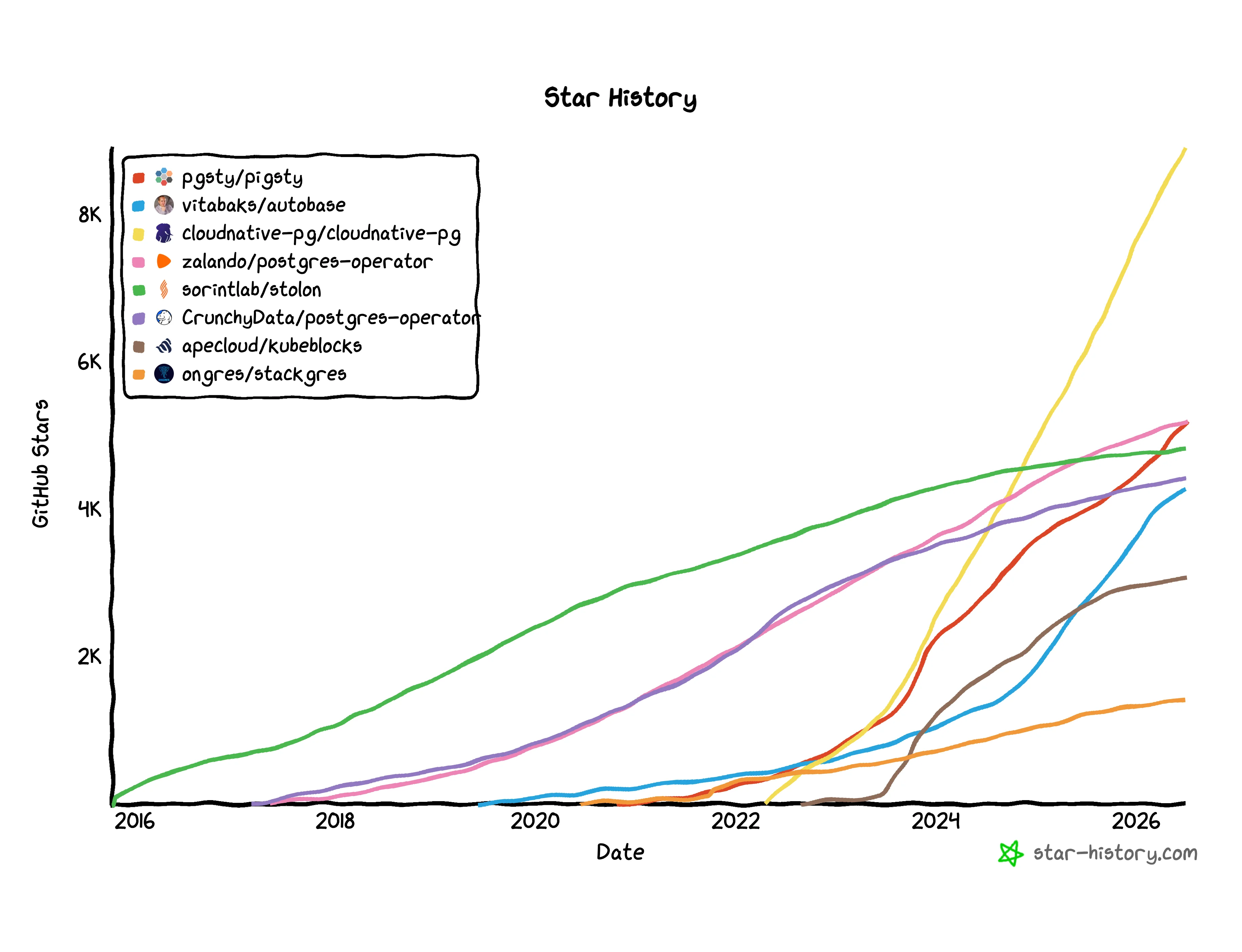
As an open-source project, Pigsty has developed quite well. In these years of full-time work, Pigsty’s GitHub stars grew from a few hundred to 5,213 as of 2026-07-11; it made the HN front page, and growth began snowballing.
In November 2025, Pigsty won the Magneto Award at the PostgreSQL Ecosystem Conference. In 2026, Pigsty’s subproject PGEXT.CLOUD was selected for a PGCon.Dev 2026 talk.
Pigsty became the first Chinese open-source project to appear on the stage of this core PostgreSQL ecosystem conference.
Previously, Pigsty could only run on CentOS 7, but now it covers all mainstream Linux distributions (EL, Debian, Ubuntu) across 16 operating system platforms. Supported PG major versions cover 14-18, and we maintain and integrate 575 extension plugins in the PG ecosystem.
Among these, I personally maintain over half (360+) of the extension plugins, providing out-of-the-box RPM/DEB packages. Including Pigsty itself, “based on open source, giving back to open source,” this is our way of contributing to the PG ecosystem.
Pigsty’s positioning has also continuously evolved from a PostgreSQL database distribution to an open-source cloud database. It truly benchmarks against cloud vendors’ entire cloud database brands.
Rebel Against Public Clouds
Public cloud vendors like AWS, Azure, GCP, and Aliyun have provided many conveniences for startups, but they are closed-source and force users to rent infrastructure at exorbitant fees.
We believe that excellent database services, like excellent database kernels, should be accessible to every user, rather than requiring expensive rental from cyber lords.
Cloud computing’s agility and elasticity value proposition is strong, but it should be free, open-source, inclusive, and local-first —
We believe the cloud computing universe needs a solution representing open-source values that returns infrastructure control to users without sacrificing the benefits of the cloud.
I hope that in the future world, everyone will have the de facto right to freely use excellent services, rather than being confined to a few cyber lord public cloud giants’ territories as cyber tenants or even cyber serfs.
This is exactly what Pigsty aims to do — a better, free and open-source RDS alternative. Allowing users to spin up database services better than cloud RDS anywhere (including cloud servers) with one click.
Pigsty is a complete complement to PostgreSQL, and a spicy mockery of cloud databases.
It literally means “pigsty,” but it’s also an acronym for Postgres In Great STYle, meaning “PostgreSQL in its full glory.”
Pigsty itself is completely open-source and free software, so you can build a PostgreSQL service that scores 90 without database experts.
We sustain operations by providing premium consulting services to take you from 90 to 100, with warranty, Q&A, and a safety net.
A well-built system may run for years without needing a “safety net,” but database problems, once they occur, are never small.
Often, expert experience can turn decay into magic, and we provide such premium consulting —
we believe this is a more just, reasonable, and sustainable model.
About the Team
I am Feng Ruohang, the author of Pigsty. Almost all of Pigsty’s code is developed by me alone.
Individual heroism still exists in the software field. Only unique individuals can create unique works — I hope Pigsty becomes such a work.
If you’re interested in me, here’s my personal homepage: https://vonng.com/
PG High Availability & Disaster Recovery Best Practices
2023-03-23
Live Stream
Bytebase x Pigsty
Best Practices for Managing PostgreSQL: Bytebase x Pigsty
2023-03-04
Tech Summit
PostgreSQL China Conference
Challenging RDS, Pigsty v2.0 Release
2023-02-01
Tech Summit
DTCC 2022
Open Source RDS Alternative: Battery-Included, Self-Driving Database Distro Pigsty
2022-07-21
Live Debate
Cloud Swallows Open Source
Can Open Source Strike Back Against Cloud?
2022-07-04
Interview
Creator’s Story
Post-90s Developer Quits to Start Up, Aiming to Challenge Cloud Databases
2022-06-28
Live Stream
Bass’s Roundtable
DBA’s Gospel: SQL Audit Best Practices
2022-06-12
Demo Day
MiraclePlus S22 Demo Day
User-Friendly Cost-Effective Database Distribution Pigsty
2022-06-05
Live Stream
PG Chinese Community Sharing
Pigsty v1.5 Quick Start, New Features & Production Cluster Setup
4 - Roadmap
Future feature planning, new feature release schedule, and todo list.
Release Strategy
Pigsty uses semantic versioning: <major>.<minor>.<patch>. Alpha/Beta/RC versions will have suffixes like -a1, -b1, -c1 appended to the version number.
Major version updates signify incompatible foundational changes and major new features; minor version updates typically indicate regular feature updates and small API changes; patch version updates mean bug fixes and package version updates.
Pigsty plans to release one major version update per year. Minor version updates usually follow PostgreSQL’s minor version update rhythm, catching up within a month at the latest after a new PostgreSQL version is released.
Pigsty typically plans 4-6 minor versions per year. For complete release history, please refer to Release Notes.
Deploy with Specific Version Numbers
Pigsty develops using the main trunk branch. Please always use Releases with version numbers.
Unless you know what you’re doing, do not use GitHub’s main branch. Always check out and use a specific version.
Chinese users are mainly active in WeChat groups. Currently, there are seven active groups. Groups 1-4 are full; for other groups, you need to add the assistant’s WeChat to be invited.
To join the WeChat community, search for “Pigsty小助手” (WeChat ID: pigsty-cc), note or send “加群” (join group), and the assistant will invite you to the group.
When you encounter problems using Pigsty, you can seek help from the community. The more information you provide, the more likely you are to get help from the community.
Please refer to the Community Help Guide and provide as much information as possible so that community members can help you solve the problem. Here is a reference template for asking for help:
What happened? (Required)
Pigsty version and OS version (Required)
$ grep version pigsty.yml

$ cat /etc/os-release

$ uname -a
Some cloud providers have customized standard OS distributions. You can tell us which cloud provider’s OS image you are using.
If you have customized and modified the environment after installing the OS, or if there are specific security rules and firewall configurations in your LAN, please also inform us when asking questions.
Pigsty configuration file
Please don’t forget to redact any sensitive information: passwords, internal keys, sensitive configurations, etc.
cat ~/pigsty/pigsty.yml
What did you expect to happen?
Please describe what should happen under normal circumstances, and how the actual situation differs from expectations.
How to reproduce this issue?
Please tell us in as much detail as possible how to reproduce this issue.
Monitoring screenshots
If you are using the monitoring system provided by Pigsty, you can provide relevant screenshots.
Error logs
Please provide logs related to the error as much as possible. Please do not paste content like “Failed to start xxx service” that has no informational value.
You can query logs from Grafana / VictoriaLogs, or get logs from the following locations:
Syslog: /var/log/messages (rhel) or /var/log/syslog (debian)
The more information and context you provide, the more likely we can help you solve the problem.
6 - Privacy Policy
What user data does Pigsty software and website collect, and how will we process your data and protect your privacy?
Pigsty Software
When you install Pigsty software, if you use offline package installation in a network-isolated environment, we will not receive any data about you.
If you choose online installation, when downloading related packages, our servers or cloud provider servers will automatically log the visiting machine’s IP address and/or hostname in the logs, along with the package names you downloaded.
We will not share this information with other organizations unless required by law. (Honestly, we’d have to be really bored to look at this stuff.)
Pigsty’s primary domain is: pigsty.io. For mainland China, please use the registered mirror site pigsty.cc.
Pigsty Website
When you visit our website, our servers will automatically log your IP address and/or hostname in Nginx logs.
We will only store information such as your email address, name, and location when you decide to send us such information by completing a survey or registering as a user on one of our websites.
We collect this information to help us improve website content, customize web page layouts, and contact people for technical and support purposes. We will not share your email address with other organizations unless required by law.
This website uses Google Analytics, a web analytics service provided by Google, Inc. (“Google”). Google Analytics uses “cookies,” which are text files placed on your computer to help the website analyze how users use the site.
The information generated by the cookie about your use of the website (including your IP address) will be transmitted to and stored by Google on servers in the United States. Google will use this information to evaluate your use of the website, compile reports on website activity for website operators, and provide other services related to website activity and internet usage.
Google may also transfer this information to third parties if required by law or where such third parties process the information on Google’s behalf. Google will not associate your IP address with any other data held by Google.
You may refuse the use of cookies by selecting the appropriate settings on your browser, however, please note that if you do this, you may not be able to use the full functionality of this website. By using this website, you consent to the processing of data about you by Google in the manner and for the purposes set out above.
If you have any questions or comments about this policy, or request deletion of personal data, you can contact us by sending an email to rh@vonng.com
7 - License
Pigsty’s open-source licenses — Apache-2.0 and CC BY 4.0
License Summary
Pigsty core uses Apache-2.0; documentation uses CC BY 4.0.
Apache-2.0 is a permissive open-source license. You may freely use, modify, and distribute the software for commercial purposes without opening your own source code or adopting the same license.
What This License Grants
What This License Does NOT Grant
License Conditions
Commercial use
Trademark use
Include license and copyright notice
Modification
Liability & warranty
State changes
Distribution
Patent grant
Private use
Pigsty Documentation
Pigsty documentation sites (pigsty.cc, pigsty.io, pgsty.com) use Creative Commons Attribution 4.0 International (CC BY 4.0).
Required: Essential core capabilities, no option to disable
Recommended: Enabled by default, can be disabled via configuration
Optional: Not enabled by default, can be enabled via configuration
Apache-2.0 License Text
                                 Apache License
                           Version 2.0, January 2004
                        http://www.apache.org/licenses/

   TERMS AND CONDITIONS FOR USE, REPRODUCTION, AND DISTRIBUTION

   1. Definitions.

      "License" shall mean the terms and conditions for use, reproduction,
      and distribution as defined by Sections 1 through 9 of this document.

      "Licensor" shall mean the copyright owner or entity authorized by
      the copyright owner that is granting the License.

      "Legal Entity" shall mean the union of the acting entity and all
      other entities that control, are controlled by, or are under common
      control with that entity. For the purposes of this definition,
      "control" means (i) the power, direct or indirect, to cause the
      direction or management of such entity, whether by contract or
      otherwise, or (ii) ownership of fifty percent (50%) or more of the
      outstanding shares, or (iii) beneficial ownership of such entity.

      "You" (or "Your") shall mean an individual or Legal Entity
      exercising permissions granted by this License.

      "Source" form shall mean the preferred form for making modifications,
      including but not limited to software source code, documentation
      source, and configuration files.

      "Object" form shall mean any form resulting from mechanical
      transformation or translation of a Source form, including but
      not limited to compiled object code, generated documentation,
      and conversions to other media types.

      "Work" shall mean the work of authorship, whether in Source or
      Object form, made available under the License, as indicated by a
      copyright notice that is included in or attached to the work
      (an example is provided in the Appendix below).

      "Derivative Works" shall mean any work, whether in Source or Object
      form, that is based on (or derived from) the Work and for which the
      editorial revisions, annotations, elaborations, or other modifications
      represent, as a whole, an original work of authorship. For the purposes
      of this License, Derivative Works shall not include works that remain
      separable from, or merely link (or bind by name) to the interfaces of,
      the Work and Derivative Works thereof.

      "Contribution" shall mean any work of authorship, including
      the original version of the Work and any modifications or additions
      to that Work or Derivative Works thereof, that is intentionally
      submitted to Licensor for inclusion in the Work by the copyright owner
      or by an individual or Legal Entity authorized to submit on behalf of
      the copyright owner. For the purposes of this definition, "submitted"
      means any form of electronic, verbal, or written communication sent
      to the Licensor or its representatives, including but not limited to
      communication on electronic mailing lists, source code control systems,
      and issue tracking systems that are managed by, or on behalf of, the
      Licensor for the purpose of discussing and improving the Work, but
      excluding communication that is conspicuously marked or otherwise
      designated in writing by the copyright owner as "Not a Contribution."

      "Contributor" shall mean Licensor and any individual or Legal Entity
      on behalf of whom a Contribution has been received by Licensor and
      subsequently incorporated within the Work.

   2. Grant of Copyright License. Subject to the terms and conditions of
      this License, each Contributor hereby grants to You a perpetual,
      worldwide, non-exclusive, no-charge, royalty-free, irrevocable
      copyright license to reproduce, prepare Derivative Works of,
      publicly display, publicly perform, sublicense, and distribute the
      Work and such Derivative Works in Source or Object form.

   3. Grant of Patent License. Subject to the terms and conditions of
      this License, each Contributor hereby grants to You a perpetual,
      worldwide, non-exclusive, no-charge, royalty-free, irrevocable
      (except as stated in this section) patent license to make, have made,
      use, offer to sell, sell, import, and otherwise transfer the Work,
      where such license applies only to those patent claims licensable
      by such Contributor that are necessarily infringed by their
      Contribution(s) alone or by combination of their Contribution(s)
      with the Work to which such Contribution(s) was submitted. If You
      institute patent litigation against any entity (including a
      cross-claim or counterclaim in a lawsuit) alleging that the Work
      or a Contribution incorporated within the Work constitutes direct
      or contributory patent infringement, then any patent licenses
      granted to You under this License for that Work shall terminate
      as of the date such litigation is filed.

   4. Redistribution. You may reproduce and distribute copies of the
      Work or Derivative Works thereof in any medium, with or without
      modifications, and in Source or Object form, provided that You
      meet the following conditions:

      (a) You must give any other recipients of the Work or
          Derivative Works a copy of this License; and

      (b) You must cause any modified files to carry prominent notices
          stating that You changed the files; and

      (c) You must retain, in the Source form of any Derivative Works
          that You distribute, all copyright, patent, trademark, and
          attribution notices from the Source form of the Work,
          excluding those notices that do not pertain to any part of
          the Derivative Works; and

      (d) If the Work includes a "NOTICE" text file as part of its
          distribution, then any Derivative Works that You distribute must
          include a readable copy of the attribution notices contained
          within such NOTICE file, excluding those notices that do not
          pertain to any part of the Derivative Works, in at least one
          of the following places: within a NOTICE text file distributed
          as part of the Derivative Works; within the Source form or
          documentation, if provided along with the Derivative Works; or,
          within a display generated by the Derivative Works, if and
          wherever such third-party notices normally appear. The contents
          of the NOTICE file are for informational purposes only and
          do not modify the License. You may add Your own attribution
          notices within Derivative Works that You distribute, alongside
          or as an addendum to the NOTICE text from the Work, provided
          that such additional attribution notices cannot be construed
          as modifying the License.

      You may add Your own copyright statement to Your modifications and
      may provide additional or different license terms and conditions
      for use, reproduction, or distribution of Your modifications, or
      for any such Derivative Works as a whole, provided Your use,
      reproduction, and distribution of the Work otherwise complies with
      the conditions stated in this License.

   5. Submission of Contributions. Unless You explicitly state otherwise,
      any Contribution intentionally submitted for inclusion in the Work
      by You to the Licensor shall be under the terms and conditions of
      this License, without any additional terms or conditions.
      Notwithstanding the above, nothing herein shall supersede or modify
      the terms of any separate license agreement you may have executed
      with Licensor regarding such Contributions.

   6. Trademarks. This License does not grant permission to use the trade
      names, trademarks, service marks, or product names of the Licensor,
      except as required for reasonable and customary use in describing the
      origin of the Work and reproducing the content of the NOTICE file.

   7. Disclaimer of Warranty. Unless required by applicable law or
      agreed to in writing, Licensor provides the Work (and each
      Contributor provides its Contributions) on an "AS IS" BASIS,
      WITHOUT WARRANTIES OR CONDITIONS OF ANY KIND, either express or
      implied, including, without limitation, any warranties or conditions
      of TITLE, NON-INFRINGEMENT, MERCHANTABILITY, or FITNESS FOR A
      PARTICULAR PURPOSE. You are solely responsible for determining the
      appropriateness of using or redistributing the Work and assume any
      risks associated with Your exercise of permissions under this License.

   8. Limitation of Liability. In no event and under no legal theory,
      whether in tort (including negligence), contract, or otherwise,
      unless required by applicable law (such as deliberate and grossly
      negligent acts) or agreed to in writing, shall any Contributor be
      liable to You for damages, including any direct, indirect, special,
      incidental, or consequential damages of any character arising as a
      result of this License or out of the use or inability to use the
      Work (including but not limited to damages for loss of goodwill,
      work stoppage, computer failure or malfunction, or any and all
      other commercial damages or losses), even if such Contributor
      has been advised of the possibility of such damages.

   9. Accepting Warranty or Additional Liability. While redistributing
      the Work or Derivative Works thereof, You may choose to offer,
      and charge a fee for, acceptance of support, warranty, indemnity,
      or other liability obligations and/or rights consistent with this
      License. However, in accepting such obligations, You may act only
      on Your own behalf and on Your sole responsibility, not on behalf
      of any other Contributor, and only if You agree to indemnify,
      defend, and hold each Contributor harmless for any liability
      incurred by, or claims asserted against, such Contributor by reason
      of your accepting any such warranty or additional liability.

   END OF TERMS AND CONDITIONS

   APPENDIX: How to apply the Apache License to your work.

      To apply the Apache License to your work, attach the following
      boilerplate notice, with the fields enclosed by brackets "[]"
      replaced with your own identifying information. (Don't include
      the brackets!)  The text should be enclosed in the appropriate
      comment syntax for the file format. We also recommend that a
      file or class name and description of purpose be included on the
      same "printed page" as the copyright notice for easier
      identification within third-party archives.

   Copyright (C) 2018-2026  Ruohang Feng, @Vonng (rh@vonng.com)

   Licensed under the Apache License, Version 2.0 (the "License");
   you may not use this file except in compliance with the License.
   You may obtain a copy of the License at

       http://www.apache.org/licenses/LICENSE-2.0

   Unless required by applicable law or agreed to in writing, software
   distributed under the License is distributed on an "AS IS" BASIS,
   WITHOUT WARRANTIES OR CONDITIONS OF ANY KIND, either express or implied.
   See the License for the specific language governing permissions and
   limitations under the License.
8 - Sponsor Us
Pigsty sponsors and investors list - thank you for your support of this project!
Sponsor Us
Pigsty is a free and open-source software, passionately developed by PostgreSQL community members, aiming to integrate the power of the PostgreSQL ecosystem and promote the widespread adoption of PostgreSQL.
If our work has helped you, please consider sponsoring or supporting our project:
Sponsor us directly with financial support - express your sincere support in the most direct and powerful way!
Consider purchasing our Technical Support Services. We can provide professional PostgreSQL high-availability cluster deployment and maintenance services, making your budget worthwhile!
Share your Pigsty use cases and experiences through articles, talks, and videos.
Allow us to mention your organization in “Users of Pigsty.”
Recommend/refer our project and services to friends, colleagues, and clients in need.
Follow our WeChat Official Account and share relevant technical articles to groups and your social media.
Angel Investors
Pigsty is a project invested by Miracle Plus (formerly YC China) S22. We thank Miracle Plus and Dr. Qi Lu for their support of this project!
Sponsors
Special thanks to Vercel for sponsoring pigsty and hosting the Pigsty website.
Special thanks to JetBrains for sponsoring Pigsty with JetBrains Open Source License
9 - User Cases
Pigsty customer and application cases across various domains and industries
According to Google Analytics PV and download statistics, Pigsty currently has approximately 100,000 users, with half from mainland China and half from other regions globally.
They span across multiple industries including internet, cloud computing, finance, autonomous driving, manufacturing, tech innovation, ISV, and defense.
If you are using Pigsty and are willing to share your case and Logo with us, please contact us - we offer one free consultation session as a token of appreciation.
Internet
Tantan: 200+ physical machines for PostgreSQL and Redis services
Bilibili: Supporting PostgreSQL innovative business
Cloud Vendors
Bitdeer: Providing PG DBaaS
Oracle OCI: Using Pigsty to deliver PostgreSQL clusters
Pigsty Professional/Enterprise subscription service - When you encounter difficulties related to PostgreSQL and Pigsty, our subscription service provides you with comprehensive support.
Pigsty aims to unite the power of the PostgreSQL ecosystem and help users make the most of the world’s most popular database, PostgreSQL, with self-driving database management software.
While Pigsty itself has already resolved many issues in PostgreSQL usage, achieving truly enterprise-grade service quality requires expert support and comprehensive coverage from the original provider.
We deeply understand the importance of professional commercial support for enterprise customers. Therefore, Pigsty Enterprise Edition provides a series of value-added services on top of the open-source version, helping users better utilize PostgreSQL and Pigsty for customers to choose according to their needs.
If you have any of the following needs, please consider Pigsty subscription service:
Running databases in critical scenarios requiring strict SLA guarantees and comprehensive coverage.
Need comprehensive support for complex issues related to Pigsty and PostgreSQL.
Seeking guidance on PostgreSQL/Pigsty production environment best practices.
Want experts to help interpret monitoring dashboards, analyze and identify performance bottlenecks and fault root causes, and provide recommendations.
Need to plan database architectures that meet security/disaster recovery/compliance requirements based on existing resources and business needs.
Need to migrate from other databases to PostgreSQL, or migrate and transform legacy instances.
Building an observability system, data dashboards, and visualization applications based on the Victoria/Grafana technology stack.
Migrating off cloud and seeking open-source alternatives to RDS for PostgreSQL - cloud-neutral, vendor lock-in-free solutions.
Want professional support for Redis/ETCD/Silo, as well as extensions like TimescaleDB/Citus.
Want to perform secondary development and OEM branding with explicit commercial authorization.
Want to sell Pigsty as SaaS/PaaS/DBaaS, or provide technical services/consulting/cloud services based on this distribution.
Note on https://pigsty.io/price: The https://pigsty.io/price page is a simplified global pricing landing page (USD pricing, includes the Standard tier and node-cap presets). This page is the detailed subscription reference (CNY pricing, delivery scope, and OS/PG compatibility matrix). For technical compatibility boundaries, this page and Supported Linux prevail.
Pigsty Open Source Edition (OSS)Free and Open Source
No scale limit, no warranty
License:Apache-2.0 PG Support: 18 (default), 14–18 available Architecture Support: x86_64, Arm64 OS Support: Latest minor versions of three families
Support: 2 person-days included per year Repository: China mainland mirror sites Delivery: Customized offline software package Domestic Innovation:PolarDB-O support
For critical scenarios with a strict SLA.
Pigsty Open Source Edition (OSS)
Pigsty Open Source Edition uses the Apache-2.0 license, provides complete core functionality, requires no fees, but does not guarantee any warranty service. If you find defects in Pigsty, we welcome you to submit an Issue on Github.
Pigsty Open Source supports seven currently validated baselines: EL 9.8 / 10.2, Debian 12.15 / 13.6, and Ubuntu 22.04.5 / 24.04.4 / 26.04.0, across both x86_64 and aarch64.
The historical v4.4.0 Community Edition artifacts comprise six dual-architecture offline bundles built on EL 10.1, Debian 13.6, and Ubuntu 24.04.4. Those build baselines are not the same as the currently recommended operating systems; see the offline installation guide.
Using the Pigsty open source version allows junior development/operations engineers to have 70%+ of the capabilities of professional DBAs. Even without database experts, they can easily set up a highly available, high-performance, easy-to-maintain, secure and reliable PostgreSQL database cluster.
Code
OS Distribution Version
x86_64
aarch64
PG18
PG17
PG16
PG15
PG14
EL10
RHEL 10 / Rocky10 / Alma10
el10.x86_64
el10.aarch64
EL9
RHEL 9 / Rocky9 / Alma9
el9.x86_64
el9.aarch64
U26
Ubuntu 26.04 (resolute)
u26.x86_64
u26.aarch64
U24
Ubuntu 24.04 (noble)
u24.x86_64
u24.aarch64
U22
Ubuntu 22.04 (jammy)
u22.x86_64
u22.aarch64
D13
Debian 13 (trixie)
d13.x86_64
d13.aarch64
D12
Debian 12 (bookworm)
d12.x86_64
d12.aarch64
= Primary support, = Optional support
Pigsty Professional Edition (PRO)
Professional Edition Subscription: Starting Price ¥150,000 / year
Pigsty Professional Edition subscription provides complete functional modules and warranty for Pigsty itself. For defects in PostgreSQL itself and extension plugins, we will make our best efforts to provide feedback and fixes through the PostgreSQL global developer community.
Pigsty Professional Edition is built on the open source version, fully compatible with all open source features, and provides additional modules plus broader database/OS compatibility options: we provide build options for all minor versions of eight mainstream Linux releases (EL8/9/10, Debian 12/13, Ubuntu 22/24/26).
Pigsty Professional Edition includes support for PostgreSQL 14 - 18, and tracks upstream PostgreSQL minor updates continuously (for active majors, typically day-zero or near-day availability), ensuring smooth rolling upgrades to newer majors and minors.
Pigsty Professional Edition subscription allows you to use China mainland mirror site software repositories, accessible without VPN/proxy; we will also customize offline software installation packages for your exact operating system major/minor version, ensuring normal installation and delivery in air-gapped environments, achieving autonomous and controllable deployment.
Pigsty Professional Edition subscription provides standard expert consulting services, including complex issue analysis, DBA Q&A support, backup compliance advice, etc. We commit to responding to your issues within business hours (5x8), and provide 1 person-day support per year, with optional person-day add-on options.
Pigsty Professional Edition uses a commercial license, providing additional modules, technical support, and warranty services.
Pigsty Professional Edition starting price is ¥150,000 / year, equivalent to the annual fee for 9 vCPU AWS high-availability RDS PostgreSQL, or a junior operations engineer with a monthly salary of 10,000 yuan.
Code
OS Distribution Version
x86_64
aarch64
PG18
PG17
PG16
PG15
PG14
EL10
RHEL 10 / Rocky10 / Alma10
el10.x86_64
el10.aarch64
EL9
RHEL 9 / Rocky9 / Alma9
el9.x86_64
el9.aarch64
EL8
RHEL 8 / Rocky8 / Alma8 / Anolis8
el8.x86_64
el8.aarch64
U26
Ubuntu 26.04 (resolute)
u26.x86_64
u26.aarch64
U24
Ubuntu 24.04 (noble)
u24.x86_64
u24.aarch64
U22
Ubuntu 22.04 (jammy)
u22.x86_64
u22.aarch64
D13
Debian 13 (trixie)
d13.x86_64
d13.aarch64
D12
Debian 12 (bookworm)
d12.x86_64
d12.aarch64
Pigsty Enterprise Edition
Enterprise Edition Subscription: Starting Price ¥400,000 / year
Pigsty Enterprise Edition subscription includes all service content provided by the Pigsty Professional Edition subscription, plus the following value-added service items:
Pigsty Enterprise Edition subscription provides the broadest range of database/operating system version support, including extended support for EOL operating systems (EL7, D11), domestic operating systems, cloud vendor operating systems, and legacy PostgreSQL major versions (PG12+ on request), as well as full support for Arm64 architecture chips.
Pigsty Enterprise Edition subscription provides domestic innovation and localization solutions, allowing you to use PolarDB v2.0 (this kernel license needs to be purchased separately) kernel to replace the native PostgreSQL kernel and meet local compliance requirements.
Pigsty Enterprise Edition subscription provides higher-standard enterprise-level consulting services, committing to 7x24 with (< 1h) response time SLA, and can provide more types of consulting support: version upgrades, performance bottleneck identification, annual architecture review, extension plugin integration, etc.
Pigsty Enterprise Edition subscription includes 2 person-days of support per year, with optional person-day add-on options, for resolving more complex and time-consuming issues.
Pigsty Enterprise Edition allows you to use Pigsty for DBaaS purposes, building cloud database services for external sales.
Pigsty Enterprise Edition starting price is ¥400,000 / year, equivalent to the annual fee for 24 vCPU AWS high-availability RDS, or an operations expert with a monthly salary of 30,000 yuan.
Code
OS Distribution Version
x86_64
aarch64
PG18
PG17
PG16
PG15
PG14
PG13
PG12
EL10
RHEL 10 / Rocky10 / Alma10
el10.x86_64
el10.aarch64
EL9
RHEL 9 / Rocky9 / Alma9
el9.x86_64
el9.aarch64
EL8
RHEL 8 / Rocky8 / Alma8 / Anolis8
el8.x86_64
el8.aarch64
U26
Ubuntu 26.04 (resolute)
u26.x86_64
u26.aarch64
U24
Ubuntu 24.04 (noble)
u24.x86_64
u24.aarch64
U22
Ubuntu 22.04 (jammy)
u22.x86_64
u22.aarch64
D13
Debian 13 (trixie)
d13.x86_64
d13.aarch64
D12
Debian 12 (bookworm)
d12.x86_64
d12.aarch64
D11
Debian 11 (bullseye)
d11.x86_64
d11.aarch64
EL7
RHEL7 / CentOS7 / UOS …
el7.x86_64
-
Pigsty Subscription Notes
Feature Differences
Pigsty Professional/Enterprise Edition includes the following additional features compared to the open source version:
Command Line Management Tool: Unlock the full functionality of the Pigsty command line tool (pig)
System Customization Capability: Provide pre-built offline installation packages for exact mainstream Linux operating system distribution major/minor versions
Offline Installation Capability: Complete Pigsty installation in environments without Internet access (air-gapped environments)
Multi-version PG Kernel: Allow users to freely specify and install PostgreSQL major versions within the lifecycle (14 - 18)
Kernel Replacement Capability: Allow users to use other PostgreSQL-compatible kernels to replace the native PG kernel, and the ability to install these kernels offline
Babelfish: Provides Microsoft SQL Server wire protocol-level compatibility
IvorySQL: Based on PG, provides Oracle syntax/type/stored procedure compatibility
PolarDB PG: Provides support for open-source PolarDB for PostgreSQL kernel
PolarDB O: Domestic innovation database with Oracle-compatible kernel for local compliance requirements (Enterprise Edition subscription only)
Extension Support Capability: Provides out-of-the-box installation for 575 available PG extensions for PG 14-18 on mainstream operating systems.
Complete Functional Modules: Provides all functional modules:
Silo: Enterprise PB-level object storage planning and self-hosting
DuckDB: Provides comprehensive DuckDB support, and PostgreSQL + DuckDB OLAP extension plugin support
Kafka: Provides high-availability Kafka cluster deployment and monitoring
Kubernetes, VictoriaMetrics & VictoriaLogs
Domestic Operating System Support: Provides domestic innovation OS support options (Enterprise Edition subscription only)
Domestic ARM Architecture Support: Provides domestic ARM64 architecture support options (Enterprise Edition subscription only)
China Mainland Mirror Repository: Smooth installation without VPN, providing domestic YUM/APT repository mirrors and DockerHub access proxy.
Chinese Interface Support: Monitoring system Chinese interface support (Beta)
Payment Model
Pigsty subscription uses an annual payment model. After signing the contract, the one-year validity period is calculated from the contract date. If payment is made before the subscription contract expires, it is considered automatic renewal.
Consecutive subscriptions have discounts. The first renewal (second year) enjoys a 95% discount, the second and subsequent renewals enjoy a 90% discount on subscription fees, and one-time subscriptions for three years or more enjoy an overall 85% discount.
After the annual subscription contract terminates, you can choose not to renew the subscription service. Pigsty will no longer provide software updates, technical support, and consulting services, but you can continue to use the already installed version of Pigsty Professional Edition software.
If you subscribed to Pigsty professional services and choose not to renew, when re-subscribing you do not need to make up for the subscription fees during the interruption period, but all discounts and benefits will be reset.
Pigsty’s pricing strategy ensures value for money - you can immediately get top DBA’s database architecture construction solutions and management best practices, with their consulting support and comprehensive coverage;
while the cost is highly competitive compared to hiring database experts full-time or using cloud databases. Here are market references for enterprise-level database professional service pricing:
Oracle Annual Service Fee: (Enterprise $47,500 + Rac $23,000) * 22% per year, equivalent to 28K/year (per vCPU)
The fair price for decent database professional services is 10,000 ~ 20,000 yuan / year, with the billing unit being vCPU, i.e., one CPU thread (1 Intel core = 2 vCPU threads).
Pigsty provides top-tier PostgreSQL expert services in China and adopts a per-node billing model. On commonly seen high-core-count server nodes, it brings users an unparalleled cost reduction and efficiency improvement experience.
Pigsty Expert Services
In addition to Pigsty subscription, Pigsty also provides on-demand Pigsty x PostgreSQL expert services - industry-leading database experts available for consultation.
Expert Advisor: ¥300,000 / three years
Within three years, provides 10 complex case handling sessions related to PostgreSQL and Pigsty, and unlimited Q&A.
Expert Support: ¥30,000 / person·day
Industry-leading expert on-site support, available for architecture consultation, fault analysis, problem troubleshooting, database health checks, monitoring interpretation, migration assessment, teaching and training, cloud migration/de-cloud consultation, and other continuous time-consuming scenarios.
Expert Consultation: ¥3,000 / case
Consult on any questions you want to know about Pigsty, PostgreSQL, databases, cloud computing, AI…
Database veterans, cloud computing maverick sharing industry-leading insights, cognition, and judgment.
Quick Consultation: ¥300 / question
Get a quick diagnostic opinion and response to questions related to PostgreSQL / Pigsty / databases, not exceeding 5 minutes.
Contact Information
Please send an email to rh@vonng.com. Users in mainland China are welcome to add WeChat ID RuohangFeng.
11 - FAQ
Answers to frequently asked questions about the Pigsty project itself.
What is Pigsty, and what is it not?
Pigsty is a PostgreSQL database distribution, a local-first open-source RDS cloud database solution.
Pigsty is not a Database Management System (DBMS), but rather a tool, distribution, solution, and best practice for managing DBMS.
Analogy: The database is the car, then the DBA is the driver, RDS is the taxi service, and Pigsty is the autonomous driving software.
What problem does Pigsty solve?
The ability to use databases well is extremely scarce: either hire database experts at high cost to self-build (hire drivers), or rent RDS from cloud vendors at sky-high prices (hail a taxi), but now you have a new option: Pigsty (autonomous driving).
Pigsty helps users use databases well: allowing users to self-build higher-quality and more efficient local cloud database services at less than 1/10 the cost of RDS, without a DBA!
Who are Pigsty’s target users?
Pigsty has two typical target user groups. The foundation is medium to large companies building ultra-large-scale enterprise/production-grade PostgreSQL RDS / DBaaS services.
Through extreme customizability, Pigsty can meet the most demanding database management needs and provide enterprise-level support and service guarantees.
At the same time, Pigsty also provides “out-of-the-box” PG RDS self-building solutions for individual developers, small and medium enterprises lacking DBA capabilities, and the open-source community.
Why can Pigsty help you use databases well?
Pigsty embodies the experience and best practices of top experts refined in the most complex and largest-scale client PostgreSQL scenarios, productized into replicable software:
Solving extension installation, high availability, connection pooling, monitoring, backup and recovery, parameter optimization, IaC batch management, one-click installation, automated operations, and many other issues at once. Avoiding many pitfalls in advance and preventing repeated mistakes.
Why is Pigsty better than RDS?
Pigsty provides a feature set and infrastructure support far beyond RDS, including 575 extension plugins and 12+ kernel support.
Pigsty provides a unique professional-grade monitoring system in the PG ecosystem, along with architectural best practices battle-tested in complex scenarios, simple and easy to use.
Moreover, forged in top-tier client scenarios like Tantan, Apple, and Alibaba, continuously nurtured with passion and love, its depth and maturity are incomparable to RDS’s one-size-fits-all approach.
Why is Pigsty cheaper than RDS?
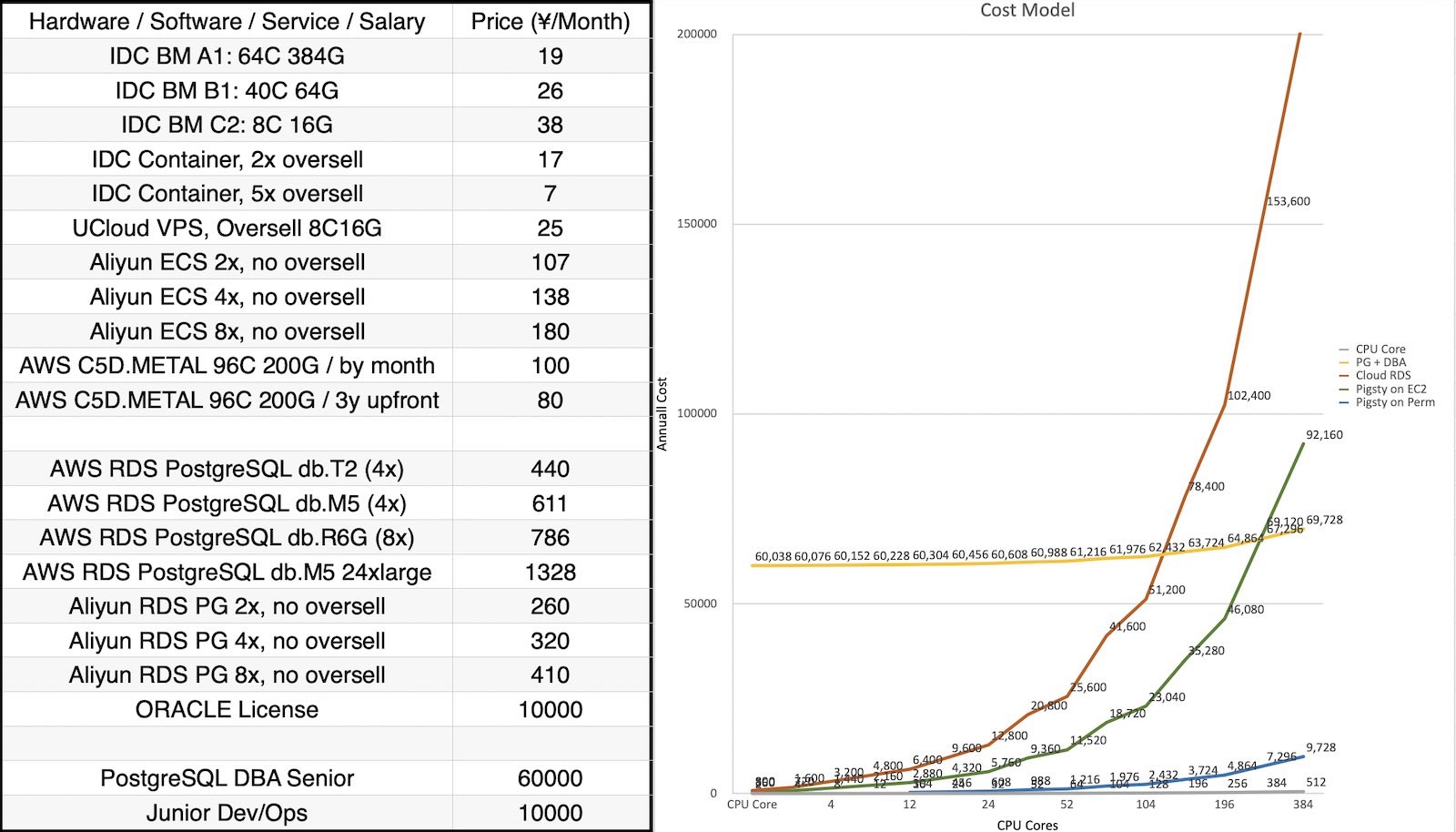
Pigsty allows you to use 10 ¥/core·month pure hardware resources to run 400¥-1400¥/core·month RDS cloud databases, and save the DBA’s salary. Typically, the total cost of ownership (TCO) of a large-scale Pigsty deployment can be over 90% lower than RDS.
Pigsty can simultaneously reduce software licensing/services/labor costs. Self-building requires no additional staff, allowing you to spend costs where it matters most.
How does Pigsty help developers?
Pigsty integrates the most comprehensive extensions in the PG ecosystem (575), providing an All-in-PG solution: a single component replacing specialized components like Redis, Kafka, MySQL, ES, vector databases, OLAP / big data analytics.
Greatly improving R&D efficiency and agility while reducing complexity costs, and developers can achieve self-service management and autonomous DevOps with Pigsty’s support, without needing a DBA.
How does Pigsty help operations?
Pigsty’s self-healing high-availability architecture ensures hardware failures don’t need immediate handling, letting ops and DBAs sleep well; monitoring aids problem analysis and performance optimization; IaC enables automated management of ultra-large-scale clusters.
Operations can moonlight as DBAs with Pigsty’s support, while DBAs can skip the system building phase, saving significant work hours and focusing on high-value work, or relaxing, learning PG.
Who is the author of Pigsty?
Pigsty is primarily developed by Feng Ruohang alone, an open-source contributor, database expert, and evangelist who has focused on PostgreSQL for 10 years,
formerly at Alibaba, Tantan, and Apple, a full-stack expert. Now the founder of a one-person company, providing professional consulting services.
He is also a tech KOL, the founder of the top WeChat database personal account “非法加冯” (Illegally Add Feng), with 60,000+ followers across all platforms.
What is Pigsty’s ecosystem position and influence?
Pigsty is the most influential Chinese open-source project in the global PostgreSQL ecosystem, with about 100,000 users, half from overseas.
Pigsty is also one of the most active open-source projects in the PostgreSQL ecosystem, currently dominating in extension distribution and monitoring systems.
PGEXT.Cloud is a PostgreSQL extension repository maintained by Pigsty, with the world’s largest PostgreSQL extension distribution volume.
It has become an upstream software supply chain for multiple international PostgreSQL vendors.
Pigsty is currently one of the major distributions in the PostgreSQL ecosystem and a challenger to cloud vendor RDS, now widely used in defense, government, healthcare, internet, finance, manufacturing, and other industries.
What scale of customers is Pigsty suitable for?
Pigsty originated from the need for ultra-large-scale PostgreSQL automated management but has been deeply optimized for ease of use. Individual developers and small-medium enterprises lacking professional DBA capabilities can also easily get started.
The largest deployment is 25K vCPU, 4.5 million QPS, 6+ years; the smallest deployment can run completely on a 1c1g VM for Demo / Devbox use.
What capabilities does Pigsty provide?
Pigsty focuses on integrating the PostgreSQL ecosystem and providing PostgreSQL best practices, but also supports a series of open-source software that works well with PostgreSQL. For example:
Etcd, Redis, Silo, DuckDB, Prometheus
FerretDB, Babelfish, IvorySQL, PolarDB, OrioleDB
OpenHalo, Supabase, Greenplum, Dify, Odoo, …
What scenarios is Pigsty suitable for?
Running large-scale PostgreSQL clusters for business
Self-building RDS, object storage, cache, data warehouse, Supabase, …
Self-building enterprise applications like Odoo, Dify, Wiki, GitLab
Running monitoring infrastructure, monitoring existing databases and hosts
Using multiple PG extensions in combination
Dashboard development and interactive data application demos, data visualization, web building
Is Pigsty open source and free?
Pigsty is 100% open-source software + free software. Under the premise of complying with the open-source license, you can use it freely and for various commercial purposes.
We value software freedom. Pigsty uses the Apache-2.0 license. Please see the license for details.
Does Pigsty provide commercial support?
Pigsty software itself is open-source and free, and provides commercial subscriptions for all budgets, providing quality assurance for Pigsty & PostgreSQL.
Subscriptions provide broader OS/PG/chip architecture support ranges, as well as expert consulting and support.
Pigsty commercial subscriptions deliver industry-leading management/technical experience/solutions,
helping you save valuable time, shouldering risks for you, and providing a safety net for difficult problems.
Does Pigsty support domestic innovation (信创)?
Pigsty software itself is not a database and is not subject to domestic innovation catalog restrictions, and already has multiple military use cases. However, the Pigsty open-source edition does not provide any form of domestic innovation support.
Commercial subscription provides domestic innovation solutions in cooperation with Alibaba Cloud, supporting the use of PolarDB-O with domestic innovation qualifications (requires separate purchase) as the RDS kernel, capable of running on domestic innovation OS/chip environments.
Can Pigsty run as a multi-tenant DBaaS?
Pigsty uses the Apache-2.0 license. You may use it for DBaaS purposes under the license terms.
For explicit commercial authorization, consider the Pigsty Enterprise subscription.
Can Pigsty’s Logo be rebranded as your own product?
When redistributing Pigsty, you must retain copyright notices, patent notices, trademark notices, and attribution notices from the original work,
and attach prominent change descriptions in modified files while preserving the content of the LICENSE file.
Under these premises, you can replace PIGSTY’s Logo and trademark, but you must not promote it as “your own original work.”
We provide commercial licensing support for OEM and rebranding in the enterprise edition.
Pigsty’s Business Entity
Pigsty is a project invested by Miracle Plus S22. The original entity Panji Cloud Data (Beijing) Technology Co., Ltd. has been liquidated and divested of the Pigsty business.
Pigsty is currently independently operated and maintained by author Feng Ruohang. The business entities are:
Hainan Zhuxia Cloud Data Co., Ltd. / 91460000MAE6L87B94
Haikou Longhua Piji Data Center / 92460000MAG0XJ569B
Haikou Longhua Yuehang Technology Center / 92460000MACCYGBQ1N
PIGSTY® and PGSTY® are registered trademarks of Haikou Longhua Yuehang Technology Center.
12 - Comparison
This article compares Pigsty with similar products and projects, highlighting feature differences.
Comparison with RDS
Pigsty is a local-first RDS alternative released under Apache-2.0, deployable on your own physical/virtual machines or cloud servers.
We’ve chosen Amazon AWS RDS for PostgreSQL (the global market leader) and Alibaba Cloud RDS for PostgreSQL (China’s market leader) as benchmarks for comparison.
Both Aliyun RDS and AWS RDS are closed-source cloud database services, available only through rental models on public clouds. The following cloud-vendor information is a February 2024 archive based on PostgreSQL 16 at that time. The Pigsty column in the Feature Comparison table is maintained against the current release, while the later Key Extensions version table remains a period snapshot.
Feature Comparison
Feature
Pigsty
Aliyun RDS
AWS RDS
Major Version Support
14 - 18
13 - 18
13 - 18
Read Replicas
Supports unlimited read replicas
Standby instances not exposed to users
Standby instances not exposed to users
Read/Write Splitting
Port-based traffic separation
Separate paid component
Separate paid component
Fast/Slow Separation
Supports offline ETL instances
Not available
Not available
Cross-Region DR
Supports standby clusters
Multi-AZ deployment supported
Multi-AZ deployment supported
Delayed Replicas
Supports delayed instances
Not available
Not available
Load Balancing
HAProxy / LVS
Separate paid component
Separate paid component
Connection Pool
Pgbouncer
Separate paid component: RDS
Separate paid component: RDS Proxy
High Availability
Patroni / etcd
Requires HA edition
Requires HA edition
Point-in-Time Recovery
pgBackRest / Silo
Backup supported
Backup supported
Metrics Monitoring
VictoriaMetrics / Exporter
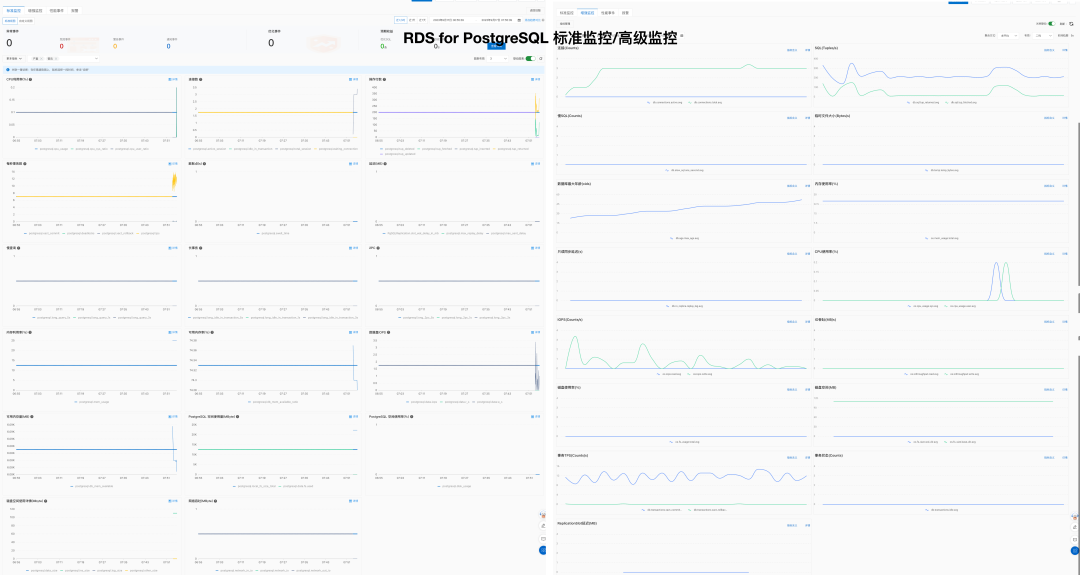
Free basic / Paid advanced
Free basic / Paid advanced
Log Collection
VictoriaLogs / Vector
Basic support
Basic support
Visualization
Grafana / Echarts
Basic monitoring
Basic monitoring
Alert Aggregation
AlertManager
Basic support
Basic support
Key Extensions
This is a historical PostgreSQL 16 extension-support snapshot based on information visible on 2024-02-28. Its versions and projects—including pg_analytics, which was later archived and removed from the catalog—are not the current Pigsty v4.5.0 or cloud-provider support matrix. Use the extension catalog for current Pigsty coverage and recheck each provider’s documentation for its current service capabilities.
Based on experience, RDS unit cost is 5-15 times that of self-hosted for software and hardware resources, with a rent-to-own ratio typically around one month. For details, see Cost Analysis.
Factor
Metric
Pigsty
Aliyun RDS
AWS RDS
Cost
Software License/Service Fee
Free, hardware ~¥20-40/core·month
¥200-400/core·month
¥400-1300/core·month
Support Service Fee
Service ~¥100/core·month
Included in RDS cost
Other On-Premises Database Management Software
Some software and vendors providing PostgreSQL management capabilities:
This article provides cost data to help you evaluate self-hosted Pigsty, cloud RDS costs, and typical DBA salaries.
Overview
The cost data below is intended to illustrate order-of-magnitude differences. Cloud vendor pricing and discounts vary over time, region, instance size, and purchase model.
EC2
Core·Month
RDS
Core·Month
DHH Self-Hosted Core-Month Price (192C 384G)
25.32
Junior Open Source DB DBA Reference Salary
¥15K/person·month
IDC Self-Hosted (Dedicated Physical: 64C384G)
19.53
Mid-Level Open Source DB DBA Reference Salary
¥30K/person·month
IDC Self-Hosted (Container, 500% Oversold)
7
Senior Open Source DB DBA Reference Salary
¥60K/person·month
UCloud Elastic VM (8C16G, Oversold)
25
ORACLE Database License
10000
Aliyun ECS 2x Memory (Dedicated, No Oversold)
107
Aliyun RDS PG 2x Memory (Dedicated)
260
Aliyun ECS 4x Memory (Dedicated, No Oversold)
138
Aliyun RDS PG 4x Memory (Dedicated)
320
Aliyun ECS 8x Memory (Dedicated, No Oversold)
180
Aliyun RDS PG 8x Memory (Dedicated)
410
AWS C5D.METAL 96C 200G (Monthly No Prepaid)
100
AWS RDS PostgreSQL db.T2 (2x)
440
AWS C5D.METAL 96C 200G (3-Year Prepaid)
80
AWS RDS PostgreSQL db.M5 (4x)
611
AWS C7A.METAL 192C 384G (3-Year Prepaid)
104.8
AWS RDS PostgreSQL db.R6G (8x)
786
RDS Cost Reference
Payment Model
Price
Annualized (¥10K)
IDC Self-Hosted (Single Physical Machine)
¥75K / 5 years
1.5
IDC Self-Hosted (2-3 Machines for HA)
¥150K / 5 years
3.0 ~ 4.5
Aliyun RDS On-Demand
¥87.36/hour
76.5
Aliyun RDS Monthly (Baseline)
¥42K / month
50
Aliyun RDS Annual (85% off)
¥425,095 / year
42.5
Aliyun RDS 3-Year Prepaid (50% off)
¥750,168 / 3 years
25
AWS On-Demand
$25,817 / month
217
AWS 1-Year No Prepaid
$22,827 / month
191.7
AWS 3-Year Full Prepaid
$120K + $17.5K/month
175
AWS China/Ningxia On-Demand
¥197,489 / month
237
AWS China/Ningxia 1-Year No Prepaid
¥143,176 / month
171
AWS China/Ningxia 3-Year Full Prepaid
¥647K + ¥116K/month
160.6
Here’s a comparison of self-hosted vs cloud database costs:
There was a time when “moving to the cloud” was almost politically correct in tech circles, and an entire generation of app developers had their vision obscured by the cloud. Let’s use real data analysis and firsthand experience to explain the value and pitfalls of the public cloud rental model — for your reference in this era of cost reduction and efficiency improvement — please see “Cloud Computing Mudslide: Collection”